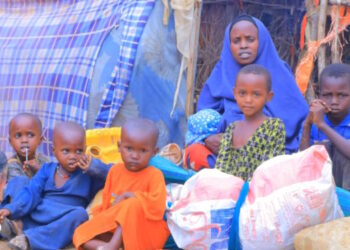


(ERGO) – Nasteho Mohamud Hashi, a single mother, has been struggling to provide for her nine children after aid she was receiving from the World Food Programme stopped in June.
The $85 monthly WFP aid that Nasteho was receiving in Hilac IDP camp in Dusamareb, in central Somalia’s Galmudug state, was critical for her family’s basic food needs as they lost their livelihood when they fled their home due to conflict.
Desperate for income, Nasteho has resorted to gathering firewood from the outskirts of Dusamareb to sell in the local market. She makes the arduous and risky journey on foot three times a week, but only earns between $2 to $3 from each trip, which is not enough to cover her family’s basic needs.
“We don’t have enough food. My children eat in the morning, and then I go to the forest to collect firewood. It’s a long walk, and the firewood is far from town now. There’s danger in the forest so I go with other people and if they leave me there, I fear for my safety,” she told Radio Ergo.
When she is unable to sell enough firewood, Nasteho asks for small amounts of food on credit from a local restaurant. Her debt has accumulated to $200. They constantly ask her to repay the money, adding to her stress.
“Sometimes they threaten to take the firewood in place of money, which is upsetting. I’ve had to delay payments three times already, and this month is the final deadline,” she explained.
Her family arrived in Hilac camp in 2023, after fleeing clan conflict in Hananbure, Galgadud. They left behind 45 goats, their primary livelihood, as well as their own two-room home. Nasteho used to make a living slaughtering livestock, making $5-6 a day. Since separating from her husband, she has been the sole provider.
In the camp, however, her family lives in a makeshift shelter made from sticks and plastic, offering little protection.
“It’s a small, fragile hut. Every few weeks, we need to repair it, but we don’t have the materials. The heat is unbearable, and when it rains, the roof leaks. I can’t protect my children or myself from the weather,” she said.
Ayni Hussein Abdullahi, another single mother of seven children, is also struggling to provide for her family in Hilac camp after the $110 she had been receiving monthly was stopped. For six months, it had ensured they had enough to eat.
“Sometimes we go without food. We used to eat three meals a day, but now we’re lucky if we eat once. It’s not like before when we had enough,” Ayni said.
To make ends meet, Ayni has been forced to wash clothes for a living, but she only earns $2-3 for a job. Often, she returns home empty-handed after spending the whole day looking for jobs. When she can’t find work, she takes food on credit, accumulating debt that she has no means to pay.
Ayni explained that while she’s away looking for work, her children are left alone and often hungry.
“We borrow food from our neighbours, and that’s how we manage to cook. But when you’ve left your children behind, they’re left to fend for themselves and sometimes they have nothing to eat. The next day, if I manage to find work, I try to repay the debt, but there are times when neighbours refuse to lend us anything until the previous debt is cleared. Sometimes the kids go without food in the morning and dinner at night. We just hope that the next day will be better,” she said.
Ayni’s family was displaced in January from Farlibah, Hiran region, following clashes between Al-Shabaab militia and the government. They left behind their 3-hectare farm that they made a living from as they fled rapidly from the insecurity.
Among the 270 families living in Hilac camp, 200 had been receiving aid. Most have fled from conflict and drought in their villages. They are not able to return home due to ongoing conflict and can’t improve their situation without external help due to their loss of livelihoods.
Hilac camp chairman, Hassan Salad Gelle, said the conditions have worsened since the aid stopped, with families forced to share whatever little they have to survive.
“The aid agencies, like WFP, say they’re running out of funds due to the large number of displaced people. They promised us two months ago that they would resume assistance, but we haven’t heard anything since,” Hassan told Radio Ergo.