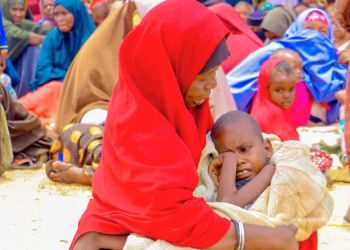


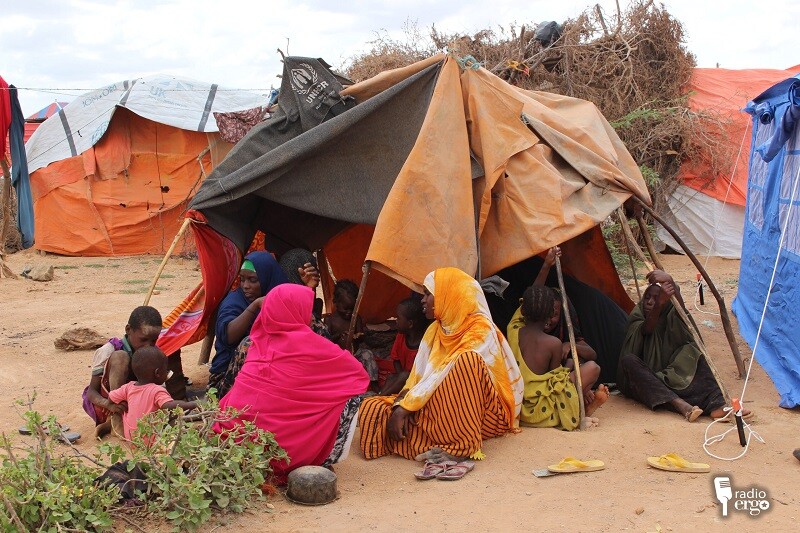
(ERGO) – Around 6,200 families from Somali Region of Ethiopia and parts of central Somalia’s Galgadud region have joined 11 IDP camps in Abudwak this month.
Many refugee families from Wardheer, Liban, and Fafan zones in Somali Region crossed the border into central Somalia and joined the camps at the beginning of February.
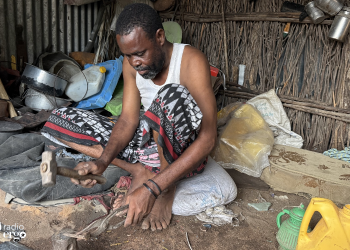
Bishar Ali Malin and his family of nine arrived in Alle-Amin camp in Abudwak after trekking for 70 kilometres from Yamargule village near the Ethiopian border town of Dollow, where they lost their entire herd of 250 goats over the last three years of drought.
They are now sharing a small shack with extended family members originally from Dhabad in Galgadud, who were already living as IDPs in the camp. They share a meal of sorghum with the family hosting them once a day.
“Our livestock were hit by the drought and when they perished we decided to go to the nearest place where we could get water or get closer to the aid organisations. Our livestock died and so we were trying to save the people. We walked for days and nights, we arrived here alive although with nothing,” he told Radio Ergo’s local reporter.
Pastoralists forced to beg
Bishar has been looking for a job to make some income for his destitute family although with masses of people flowing into the camps he has not found anything.
Once a proud and independent pastoralist, he has been going out to the market on occasions to beg.
“When I had some money I wouldn’t imagine begging, but now I no longer feel shame, because the situation has pushed us to the extreme. But I wouldn’t let myself do that before.
“If you are dying and you are presented with a poison you’re told will cure you, you will drink it!” he said.
The IDPs who were already in the camp have been feeling the burden of supporting newcomers.
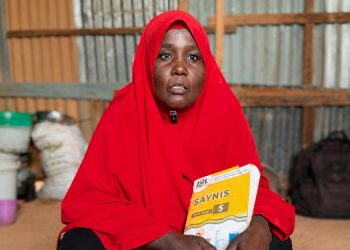
Nasra Adan Ibrahim, who has been living in the camp for five years, is hosting two new families. She said her own family was already struggling, but she felt obliged to help her relatives.
Nasra joined the camp after her 270 goats and two camels died in the drought in 2017. Her husband, the family’s breadwinner, died after being bitten by a snake in February 2022.
“We are helpless people and since my husband died, we can barely purchase water let alone food. We were alone before but now there are IDPs that have joined us, o our situation has become worse,” she said.
This mother of seven used to wash clothes, earning a scanty income, but since December she could not find work. She pulled two of her children out of Koranic school after failing to pay the fees for three months.
IDP families sleeping hungry
She is also going out to the town to beg for food for her own and the extended families.
“I have been to the city and everyone is complaining of the difficult situation, so I couldn’t get anything from anybody. Tonight I don’t have anything to cook. I have to wait for the children to go to sleep because I can’t just go back home with nothing,” she said.
The leader of the joint camp committee, Farhan Abdullahi Gulled, told Radio Ergo around 8,000 families were already living in the camps before the new waves of displaced joined in January and February.
The newcomers have not got any aid besides the other IDPs offering to share their small houses.
“When the new people arrived, there was a difficult situation. We can’t say they got help because they depend only on other IDPs. Only God can satisfy the people but there is hunger and displacement and the people are on the verge of famine,” he declared.
Lack of aid
He added that although they tried to reach out to the aid organisations and the Galmudug state government, they are still faced with hardship and despair.
The director of Galmudug’s Ministry of Humanitarian Affairs and Disaster Management, Omar Hassan Haji, said there are a total of around 700,000 IDPs in Galmudug state. They have fled drought conditions and conflict in different areas. Most were dependent on livestock for a living.
He noted that the ministry is working to ensure that the situation does not turn into a famine, although he is worried that their capacity is limited.
“If this situation continues we might not be able to do much. It’s sad to see the situation in the camps. If we work together we can do something. I am requesting the people of Galmudug to help these families and at least to help one person,” he appealed.