

(ERGO) – Hundreds of drought-hit pastoralist families stranded without food and water in remote parts of Puntland’s Banderbeyla district after losing their livestock have been walking long distances towards the main town.
Around 1,600 destitute families have moved to Banderbeyla town over the past two months from hilly, rural villages far from roads and communications networks, including Laso-Hoolad, Sarman, Maygaag, Alemoley, and Bihin villages.
Fadumo Yusuf Ahmed and her family of nine fled Alemolay village, which has not had rainfall for three consecutive rainy seasons, to travel 116 kilometres to Banderbeyla.
Fadumo, 58, said they were forced to migrate to town to find help after losing 102 goats to the drought since March. She has been raising her children alone and with no livestock left was unable to feed her children.
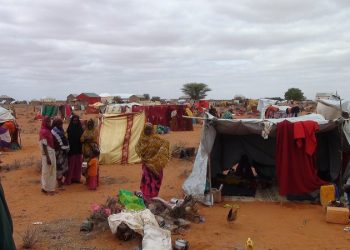
“We don’t have houses here [in Banderbeyla town], we have just set up plastic shelters which we got from some families, we also got rice and sugar from the people. We eat supper which we get sometimes and miss out sometimes. We have never been in such a situation; we previously depended on our small number of livestock to get by. We have seen drought before but we haven’t seen anything like this,” said Fadumo.
They have settled in a recently established and as yet unnamed camp, where some of her relatives have been living for a few months and share what they have with her. She says she lacks skills to work to support her family and is worried about her children, the eldest being 16.
Fadumo’s family set off from Alemoley village with five other impoverished families. They walked across parched land in searing temperatures. She described the gruelling journey:
“We were walking for three days. We didn’t have anyone die on the way, although we went through hardship, suffering and thirst. We were walking as there were no cars along the road. The land is dry with no fodder or water, and we reached Banderbeyla on foot.”
Her family still struggles to find water, and with no livestock they now have to walk to the nearest borehole 15 kilometres away and carry back the water containers on their backs. They spend more than six hours a day getting water from this borehole that was drilled four years ago outside town as a back-up source for times of scarcity.
Some of the families with remaining livestock have moved near the borehole to access water. Mohamed Khalif Malin, 70, and his family of 16 migrated from Laso-holad village a month ago after losing 380 goats, 12 camels and five donkeys within four months. He brought his 80 surviving goats.
“This is the first time we have been displaced or even moved to a different town, the reason we moved here was because there is water which is important for survival. We don’t have wealth or certainty, we moved near the water source because thirst is worse than hunger,” he explained.
They get food from the local stores on credit and eat just one meal a day. With almost no means of getting out of this dire situation, he can only reminisce about his previous life.
“We have no plans other than being patient with God’s will. We have given up now, we have been in this situation for four months, the government and the people have been made aware of our situation and we haven’t got any help … we don’t know what to say.”
A government-led committee appointed by Banderbeyla district commission in May has visited the six villages from where the mass exodus of families has occurred. The visits were challenging due to the extremely poor roads hindering accessibility as well as lack of phone network.
Aynashe Ahmed, a member of the committee, said they have shared their findings on the challenges faced by the families.
“The land is hilly with very few roads, in some parts the nearest roads are 250 to 300 kilometres away. There is a challenge with communication which means sometimes people are not able to reach where they could be evacuated or helped. Some of the worst-off people are those hit by the drought with no livestock. These people don’t have any livestock to sell, and they have not got the aid they needed,” she said.
The committee helped 500 pastoralist families with transport to Banderbeyla town where they could get food and water.
Many families in the coastal Banderbeyla area depend on fishing for a living.