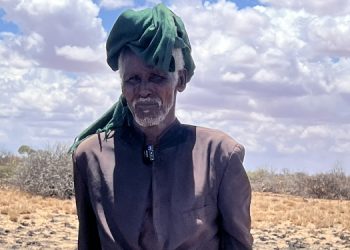
(ERGO) – Ahmed Hussein Abdi, 40, moved to Guriel at the beginning of July, hoping to find resources to save his livestock. He trekked with his family and goats for a day from Ilih village, 45 kms from Dusamareb, using their donkey cart to carry their belongings and younger children.
Life in the rural areas in this part of central Somalia was becoming impossible for many pastoralist families, with no fodder for the animals and a barrel of water costing six dollars. In town a barrel costs half a dollar.
“There is a huge difference, we are relieved that the water here is cheaper. Sometime when people at the water wells see the ailing condition of my few remaining goats, they feel pity for me and give us free water. There are also ‘gogobo’ trees (Iphonia Rotundifolia) in this area which the goats can eat,” he said.
Ahmed, a father of eight, is now working in a quarry at $5-8 a day when he gets work. The proximity of the livestock market is another advantage compared to the remote rural areas.
“I always depended on my goats for a livelihood, I would walk my goats to the market, and if I was unlucky to sell them I would walk them back. Before I came here, the trucks would charge me $1.8 to transport one goat. I can now visit the market any time and whenever the prices are high I present them for sale,” he explained.
His older son, aged 19, contributes to their income, selling firewood using the family’s donkey to transport the wood twice a week, making $15 each time.
In his heyday Ahmed owned more than 200 goats, but severe drought took a heavy toll on his livestock between the end of 2021 and beginning of 2022. He now has just 30 goats to his name but is more confident they will multiply with the better resources in the city.
“There has been drought in the area, the anticipated ‘Gu and Deyr rainy seasons both failed, the livestock perished. That is when we decided to move to the city, though it was an arduous process,” he said.
Around 30 families have arrived here in Guriel in June and July and are camped on open land given to them by the owners, where they have constructed Somali nomadic traditional huts.
Among them is Hassan Aabi Mohamud, 47, who moved from Jaw village, 40 kms south of Guriel, where the conditions were becoming unbearable for his livestock. Water was expensive and fodder scarce. He has been in the city for five weeks and his livestock are looking healthier.
“It’s God’s grace, the conditions are better today, our livestock get fodder just a kilometre away from our home. The conditions in the rural areas were dire, there was barely any water there,” said Hassan.
He moved with his 14 family members, including his two wives, and had to adapt quickly to city life. His wives work together in a butchery selling their livestock meat to make an income, earning $5 a day, which for the moment is the family’s sole income.
The income allows them to enjoy three meals a day, whereas they only had a single meal back in the village.
Five of Hassan’s 11 children have now been enrolled in school for the first time where they learn Somali and mathematics. His relatives help pay $25 for their fees.
“When you come to the city you have to adjust. I have asked my relatives to help me school the children. I have taken my three sons and two daughters to school. I never thought I would get these opportunities; I was getting desperate and thought I would have to split up my kids and send a few to different relatives,” said Hassan.
This father lost the majority of his 250 goats, with only 50 surviving the protracted drought. He said he has no plans of going back to the rural areas any time soon.