(ERGO) – Fardowsa Hussein Guleid and her family were forced to abandon their house and farm in the constantly flooding village of Hilo-kilyo to the north of Beletweyne, in Somalia’s Hiran region, and moved in July to a bleak hillside area five kilometres away.
Bananey – meaning ‘empty place’ – is a previously uninhabited area on a steep slope, lacking in all amenities. Here, like other villagers from Hilo-kilyo, she erected a flimsy hut using pieces of plastic sheeting as a roof and other scrap materials to shelter in with her bed-ridden husband and their seven children.
“Two thirds of the people here don’t have a shelter. I would have built a decent home for myself, if I could re-use the pillars from the house I left behind, but I couldn’t since they were too old and weak,” she said.
All 220 farming families who lived in Hilo-kilyo have now abandoned their homes and land and relocated to Bananey, which lacks a water source, shops, electricity, and a school.
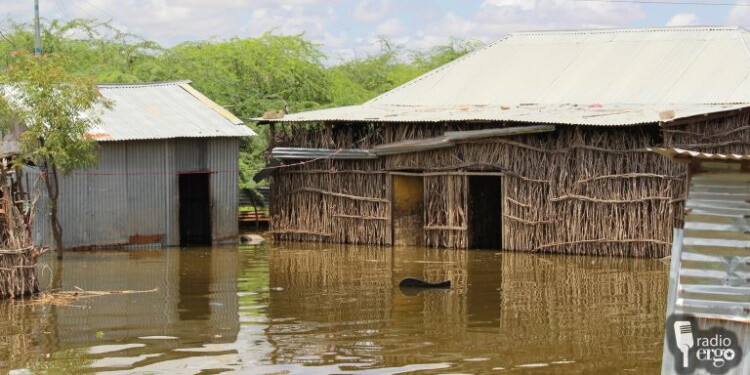
The problems for Hilo-kilyo resulted from the Beletweyne flood defence project, which has seen cemented soil barriers constructed at main breakage points along the river Shabelle, designed to protect the town from the ravages of cyclical flooding. However, when it rains, rainwater is blocked from draining into the river by the three-metre high barriers and flows instead to Hilo-kilyo causing flooding.
The last floods in May swept away Fardowsa’s family house and her tea shop, and killed their 20 sheep and the donkey she used for carrying water from the river. Their one-hectare plot was swamped. She and her neighbours had been unable to cultivate any crops for the last three rainy seasons.
The village elders met in May with the Beletweyne authorities and the Flood Management Committee. They agreed that it was best for the villagers to settle permanently in Bananey to avoid the constant loss of property and displacement. The authorities took lists of the families needing houses to be built and this encouraged the last families in Hilo-kilyo to relocate to Bananay.
Hassan Hurway Addow, one of the local elders, told Radio Ergo that the authorities and the committee promised to build new homes for the families in Bananey, although no timeframe was given. The families have not received any aid or assistance, despite the harsh conditions they are currently facing.
In order to earn a living, Fardowsa walks eight kilometres every morning to seek work on the farms on the outskirts of Beletweyne.
“I pick tomatoes and lemons on people’s farms for a small wage of $5 or $6. There are days I come back home empty handed. I am the sole breadwinner of my family, whose father is sick. We don’t even have money to take him to hospital,” she said.
As Bananey has no wells, her children walk to fetch water from the river six kilometres away. Two of her children were enrolled in Hilo-kilyo primary school but they have been out of education since 2020, when floods destroyed the school. The residents have to buy any goods they need from Beletweyne town, 10 kilometres away.
Mohamed Tahlil Mohamoud, a member of the Flood Response Committee, told Radio Ergo they were working out a plan to find a lasting solution for the Hilo-kilyo families, who have been negatively affected by the flood mitigation project.