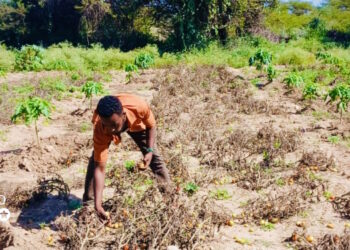


(ERGO) – Nearly a year after river floods washed away his crops for the fourth consecutive time, Nuh Adan Ahmed has once again planted grains, beans, vegetables and sesame on his three-hectare farm in southern Somalia’s Jowhar district after receiving free seeds and some money.
“The seeds we were given have helped us,” Nuh said. “I planted with the help of my kids 20 days ago.”
Nuh, a resident of Bayahaw, three kilometres east of Jowhar town, lost $1,000 he had borrowed to plant the farm in June 2020. His relatives have helped him repay $451 of the loan so far.
He was among 5,000 families in 17 villages in Jowhar supported to return to farming following destructive flooding by the river Shabelle. Local NGO, Samsam Foundation, funded by the Somalia Humanitarian Fund, distributed seeds and provided farming skills training. The 770 most vulnerable families were also given $60 a month to sustain them for three months as they wait for the harvest.
Ilyas Mohamed Sheikh, project manager at Samsam Foundation, told Radio Ergo that they conducted a survey in the villages in October and November 2020 and identified the families they thought were most affected by the floods.
Many families in Jowhar fled their homes and farms due to the Shabelle river floods, losing their livelihoods and becoming destitute.
Abdi Abdullahi Nur, whose farm was washed away by floods three times, noted that the support would get him back on his feet. He had been relying on small amounts of cash earned by two of his sons working as labourers in Mogadishu. He told Radio Ergo’s local reporter he planted the new seeds two weeks ago and hoped to be able to repay his $111 debt once he harvests.
“I was given the seeds in time before the soil on my farm dried up. I planted the next day and they have already sprouted into seedlings,” said Abdi hopefully.