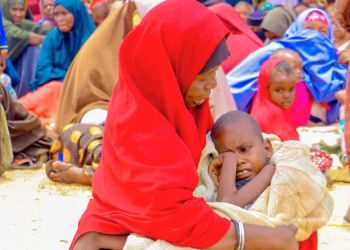


(ERGO) – A thousand students living in one of the largest internal displacement camps in Ethiopia’s Somali region have been out of school for almost a year due to COVID19 restrictions, which have also led to growing food shortages among the camp residents.
The children at the primary school in Qoloji IDP camp, 65 kilometres south of Jigjiga in Somali region’s Fafan zone, were sent home in April 2020 when the Ethiopian health ministry ordered schools to limit class numbers to contain spread of the virus.
The headmaster, Hussein Tamaan Sirad, said they had to follow the government’s order to have a maximum of 25 students per class.
“In total we had more than 4,500 students, each class had 150 students,” the headmaster told Radio Ergo. He explained that he had to send the younger students home first, whilst some of those remaining at school were learning outside because there is not enough classroom space.
The headmaster said the classrooms lacked enough chairs and students were sitting on stones. Three of the students sent home had tragically died in separate road accidents, he added.
Qoloji School, made of corrugated iron, was established by International Rescue Committee (IRC) in 2018. IRC was supplying nutritious biscuits and educational materials to the school until the outbreak of the pandemic.
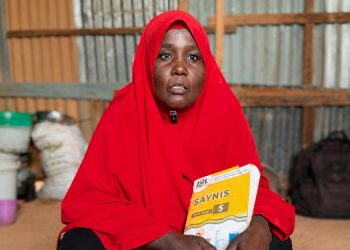
Hiis Mohamud Dahir, a resident of Qoloji camp, told Radio Ergo that her eldest daughter, aged 16, and her four other children were among those sent home from school when the outbreak started. Her five children were among 23 IDPs in the camp who tested positive for COVID19 last May in testing carried out by the region’s health authorities.
She contemplated enrolling them in a public school 40 kilometres from the camp, but could not afford the bus fare. “It worries me to see my children at home while their agemates are studying, but I have nowhere to take them,” said Hiis.
Food shortages are also being experienced by Hiis and other families in the camp. Last September, IRC and Amoud Foundation stopped their aid deliveries due to lack of funding caused by the global COVID19 lockdowns.
Hiis, who has lived in Qoloji camp for four years, said they were finding it very difficult to survive since most of the aid had stopped. They used to receive dry rations of rice, sugar, pasta and porridge but now she only receives some wheat distributed by the World Food Programme (WFP) every two or three months. She started selling women’s and children’s clothes inside the camp after receiving $200 from her brother in Bosaso, Somalia, to gain some income.
Hiis and her family fled from intercommunal conflict between Oromo and Somali communities in Babille, in East Hararghe zone of Oromia state. They lost their three-roomed house and entire herd of 156 goats. “We had wealth in Babille but now we have nothing. We are living on donations,” she said.
Hassan Abdi Mursal, head of the Somali Region Disaster Prevention and Preparedness Office, said the lives of the 13,920 families in the camp had been greatly affected by the impact of COVID19, which was also the reason for the suspension or reduction of aid delivery.
He noted that the virus had hampered last year’s resettlement plan launched by the government in 2019. The plan was suspended when some of the camp residents tested positive for the virus in mid-April 2020. Nearly 800 families had been resettled up to that point.
Hassan said that 302 of the most destitute families were resettled in Jinacsaney, 290 in Goljanno, 126 in Wardhere, and 70 in Birqod areas. At the moment there was nothing more the authorities could do.
Qoloji IDP camp was established in 2016. The residents of the camp have generally been displaced by land ownership conflicts in areas along the Oromo-Somali border.