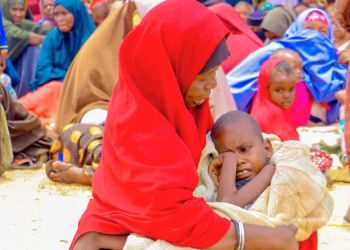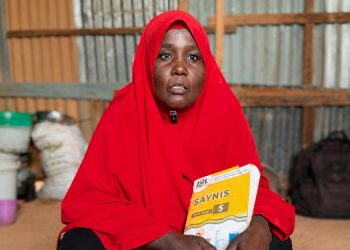


Hassan Hashi Beyle, an agro-pastoralist in central Somalia’s Guriel district, packed his seven youngest children into a rented car last week and set off on foot with his two wives, four older children, and livestock – driven away by the desert locusts that have destroyed their farm and grazing land.
“I toiled hard on the farm but I didn’t harvest anything. All that’s left is a fence and soil!” Hassan moaned, begrudging the locusts for devouring all his beans, sorghum, watermelons and red pumpkins.
Abandoning their house and land in Afrah Muse, 60 km south of Guriel, Hassan walked with his 150 goats and seven camels to Doyale, a village some 25 km away, which took them four hours.
“We are a large family, we owned a water reservoir there and that was our home,” Hassan said, finding it hard to accept his losses.
“We are here now because of the locusts, living under a tree with no shade.”
Having enough pasture and water for the livestock is imperative.
Hassan sold two of his prime animals for $110 to pay for their escape. This included $20 car rental for the small children, and $32 for 40 barrels of water that are being stored in an improvised pit lined with polythene.
The family’s own water pond in Afrah Muse had been turned foul-smelling and discoloured by the swarms of locusts that descended on it, making it unusable for people or animals.
Hundreds of families living an agro-pastoralist lifestyle in this part of Galmudug state have suffered a similar fate. Rural residents of Dabbarre, Biyo-gadud, Biyo-adde, Dhagahyale, Labiley, Afrah Muse, Gonlagonle and Galqoryale have been displaced by the locusts that have depleted the pasture.
Saney Osman Abdulle, a father of nine, moved out of Dabarre village on 19 November. Searching for pasture for the family’s herd of 120 goats and 12 camels, he settled at Nagadiweyn.
He said the community in Dabarre had not given up without a fight and had done all they could to fend off the locusts.
“We bought 16-litre spray tanks from Mogadishu and organised ourselves into groups to spray the area using Jordan pesticides. Sometimes we kept this up for 24 hours without stopping. But we were no match for the locusts, so we gave up and left,” Saney told Radio Ergo.
His five children, two daughters and five sons, were enrolled in Dabarre village school, but they have no school to go to now.
About 500 children dropped out of school. Almost half of the 250 families living in Dabarre have already left, while the rest are planning to relocate soon.
Even though those who fled have moved about 100 km away, they fear that the locusts might follow them to their new locations.
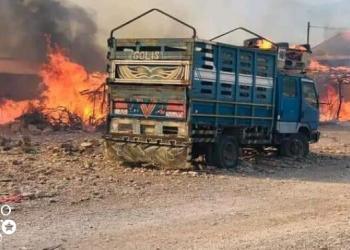
Saney described the devastation caused by the locusts as similar to fire. “It was like the entire area was burnt, up close you can see the stripped plants are still alive, but they are just scorched remains. And the locusts are still there, some barely a week old and tiny in size,” he said.
Ahmed Abdi Warsame, chairman of Dhagahyaale sub-location, 45 km south of Guriel, told Radio Ergo that of the estimated 800 families in the area, only 200 were still there and many more were planning to move if the locusts continued to destroy the vegetation.
“The locusts have caused a lot of suffering in this area and they are still there. I think they will not leave anything behind. The water reservoirs that the animals depend on have become mucky. We ask everyone, including all levels of government and the private sector, to come to the rescue of the affected people,” said Ahmed.
Galmudug Minister of Agriculture, Forestry and Pasture, Ahmed Nuur Xaaji Osman, went on an inspection tour of the area in October and described the locust swarms in Dhagahyale as the largest ever seen in Galmudug.