

(ERGO) – Measles outbreaks in rural parts of two regions of central and southern Somalia are causing concern due to the lack of access to adequate health care facilities in both places.
The measles outbreaks in Bala’d in Middle Shabelle region and Dhusamareeb in Galmudug region both began last December. In both places, medical facilities for patients are either poor or non-existent and families are using herbal remedies in the absence of formal health care.
Dr Abdullahi Ahmed Addow, representative of Hirshabelle state’s health ministry, told Radio Ergo that a team of medical staff had been dispatched to affected villages around Bala’d, including Damerow, Muqa-dere, Yaqle, and Hawadley to try to deal with the outbreak.
According to Dr Abdullahi, 30 of the 70 patients have been transported to a Mother and Child Health centre in Bal’ad town. Some patients, including children and elderly, in the villages are receiving traditional herbal medication in their homes, as there are no health posts
“There was heavy rainfall in these areas during the last Deyr season, leading to movement [displacement] of people causing congestion,” said Dr Abdullahi. “Some of those who came here had already contracted the disease and that’s how it spread to the host community,” Dr Abdullahi said.
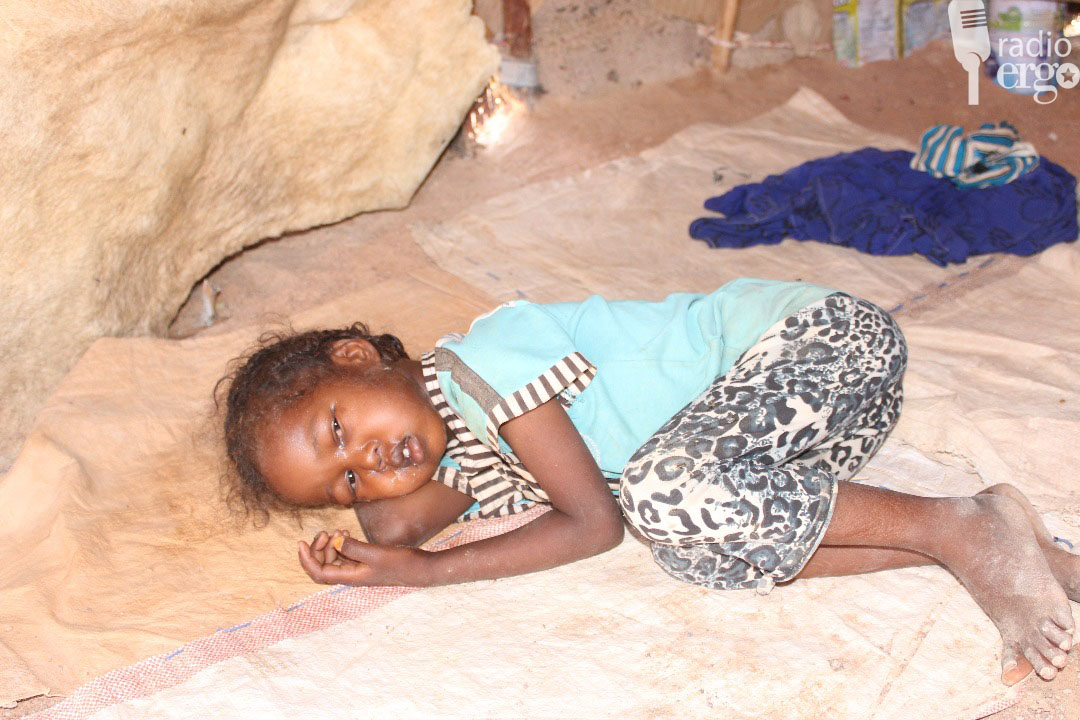
Rahmo Olow Mude, a mother of eight, who lives in Maqar-Aryes village 10 km from Bal’ad town, told Radio Ergo that four of her children were infected by measles.
“We have not visited a doctor yet but I was informed by several people who recognized the symptoms that the children have measles,” said Rahmo. Rahmo had been using a herbal solution made from a local plant called Marer (Cordia sinensis) to treat her children, as she explained.
“We use the bark of the tree (Cordia sinensis). At first, we soak it in water and when the colour of the water changes, we give the children the water to drink. They also bath with the same solution for some time,” she said.
Another parent, Sanbur Hassan, living three km from Bal’ad town, said three of his children have measles.
“I did not take them (my children) to the hospital. We treat them with goat milk because I cannot trust the medicines prescribed by the doctor at the hospital, since some of the drugs are not genuine,” said Hassan.
Meanwhile, residents of Hananbur village 55 km north of Dhusamareeb town, central Somalia, say they are unable to afford transport to the nearest hospital in the town.
Ali Nur Abdikadir, a local medical practitioner, told Radio Ergo that 12 children aged between five and 10 had been diagnosed with measles. According to Abdikadir, Hananbur medical centre, which used to offer health services, stopped operations last March after the NGO that had been supporting it, Swisso Kalmo, ceased its support due to lack of funds.
The centre had been offering free services to 5,500 of families in Hananbur and surrounding villages.
Fadumo Hashi Abdi, a mother of eight in the village, told Radio Ergo that six of her children had measles and were being nursed on herbal remedies at home. “I cannot afford to hire a car to seek medical help for my children outside this village,” she said.
Madina Hirsi Moalin told Radio Ergo that she paid $50 to transport her four-year-old son to Dhusamareeb town when he fell sick with watery diarrhoea. Unfortunately, the boy died after the eight hour journey due to dehydration.
“The closure of the [Swisso Kalmo] health centre had an impact on us because emergency cases cannot be responded to quickly. On that fateful night, I had been running up and down and failed to get help,” Madina said.
Other deaths are reported to have occurred in Hananbur due to untreated diarrhoea and measles although accurate figures were not available.