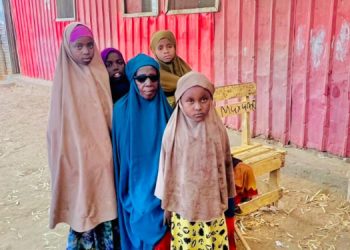


(ERGO) – More than 170 children in Maleelay 1 settlement, near the Dadaab refugee complex in Kenya’s Garissa county, are unable to attend school due to a shortage of teachers and limited education facilities.
Parents and community leaders say the only school in the settlement offers classes only up to grade six and has just three teachers, making it impossible to accommodate the growing number of children.
The school was established by the Kenyan government in 2011, but its capacity has remained largely unchanged despite a steady rise in the population, especially as drought-affected families continue to settle in the area.
Daud Ismail Yusuf, a resident of Maleelay, said the shortage of teachers had prevented two of his childrenfrom enrolling in school.
“The problem is the lack of teachers,” he told Radio Ergo. “Without teachers there can be no education. This situation affects us greatly because we want our children to learn but there is nowhere to take them.”
Three of Daud’s children are currently enrolled in the school in grades three, four, and five, but two others who finished grade six last year were forced to stop studying because there is no secondary school nearby.
He fears that even the children still in school may face the same situation unless additional education opportunities are created.
“A child finishing grade six should be able to speak Swahili [national language in Kenya] well, but with only one teacher trying to handle several classes it is very difficult.”
The lack of teachers also affects the quality of education. According to Daud, one teacher tries to manage several classes at the same time, leaving many students without proper instruction.
Education concerns are only one of several challenges facing his family of 14 people.
Daud’s eight-hectare farm has produced nothing since last year’s rainy season because of water shortages. Crops he planted during the last Gu and Deyr seasons both failed.
To support his family he relies on small loans and a tiny shop selling drinking water, but the income is too little to cover household expenses. He says the debts he accumulated from farming inputs and family needs now exceed $1,900.
“My 90-year-old father lives with us and we are facing a very difficult life. There are no jobs here. We are not near a big town where I could find labour work. Sometimes we earn 2-3,000 shillings [$15-23 approx.], but that is not enough for a family this size,” he said.
Daud’s family moved to Maleelay in 2011 after protracted drought wiped out more than 300 goats that had supported their pastoralist livelihood. Today the settlement that began with just a few families is home to about 200 households.
Some parents have become discouraged and stopped sending their children to school. Ijabo Ahmed Aden, a mother of seven, said none are currently attending Maleelay school because of previous experience with her older children.
One of them had no chance to go to a secondary school, and two were withdrawn because she felt the education was poor.
“The older children struggled and ended up leaving school without continuing. I decided the younger ones should stay home rather than go through the same disappointment,” she said.
Her younger children, aged seven and nine, are now staying at home having completed Koranic studies. Ijabo said she can’t move to another area where schools might be available because her family has no money.
Their financial situation has worsened since food aid that was distributed to some residents close to the refugee camps was stopped mid last year, when the authorities determined that she was a Kenyan citizen and therefore not eligible for the aid.
“For many years I received food assistance. But the card I used was taken away after they said I was Kenyan. Since then life has become very difficult,” she said.
Her husband searches for casual labour every morning but rarely finds work in the area. The family moved to Maleelay 15 years ago after drought killed the 200 goats and four camels in their herd.

According to Ahmed Mohamed Aden, head of the school’s parent committee, only two of the teachers have formal teaching qualifications. The school cannot accept new students unless more teachers are assigned.
“There are far more children who need education here than those currently studying,” he said. “The main problems are the shortage of teachers and the limited number of education facilities.”
The settlement is expanding with rural families moving in hoping to access water and other basic needs.
Community leaders say they have repeatedly reported the situation to government officials and education authorities but have not received a response.