

(ERGO) – Some displaced families in southern Somalia stripped of their livelihoods by drought have managed to rebuild a living after receiving a one-off cash payment from the national safety net fund run by the federal government.
Amina Ismail Omar is among the 8,040 people in Dhobley, Lower Juba region, who received a payment of $360 last September from the Bahnano programme.
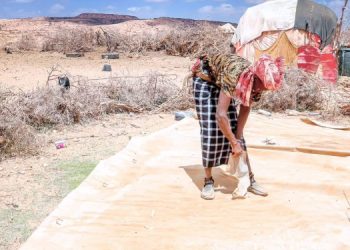
Living with her children in Danwadaag displacement camp, she invested the money in buying young goats, fattening them, and selling them for profit. This small livestock business has significantly improved her family’s living conditions.
Amina said she bought 10 young goats at $22 each and sold them for $33 after caring for them. She now earns at least $70 every two weeks.
“We had no livestock at all. Now we have animals that belong to us and can sustain our lives. In the past, whenever there was a need for education, health, or daily survival, we simply had nothing. But now we have living animals,” she told Radio Ergo.
Her herd has grown to 20 goats after she purchased pregnant goats that have since given birth, and are also providing milk for her children, whose health has improved.
Her knowledge of breeding and managing animals helped her turn the cash into a sustainable living rather than short-term consumption.
“One animal can bring a profit of around 400,000 Somali shillings. I save that money. When I collect two million shillings, I use it to manage the needs in front of me, like food, health care, or school clothing,” she said.
Amina’s family was forced into displacement after prolonged cycles of drought wiped out more than 150 animals they had been raising in rural areas of Jilib district in Middle Juba.
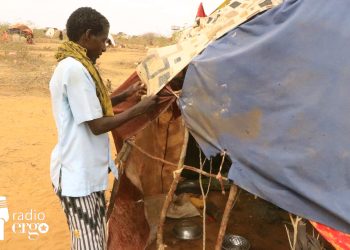
When they arrived in Dhobley, local authorities allocated her half a hectare of land to farm. However, floods at the end of 2023 destroyed the shallow well needed to irrigate the farm. Lacking funds, she and 20 other women farmers were unable to rehabilitate the well.
“We used to grow vegetables like watermelon, tomatoes, lettuce, and pumpkin that we sold in the market for cash. Our children ate vegetables regularly, and we didn’t need to buy them. The cash helped us buy food. But after the floods, many people were left with nothing,” she said.
Now caring for eight orphaned children, Amina says she no longer worries about feeding them. Her goal is to rebuild her livestock herd and eventually return to a pastoralist way of life if conditions allow.
She is proud of the way she managed the cash she was given, as not everyone invested in the future like she did: “Some received Bahnano support and had nothing left, while others, like me, managed to benefit.”
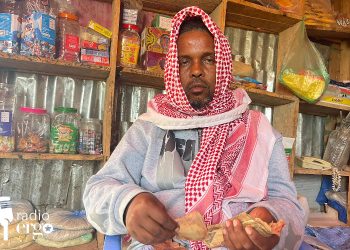
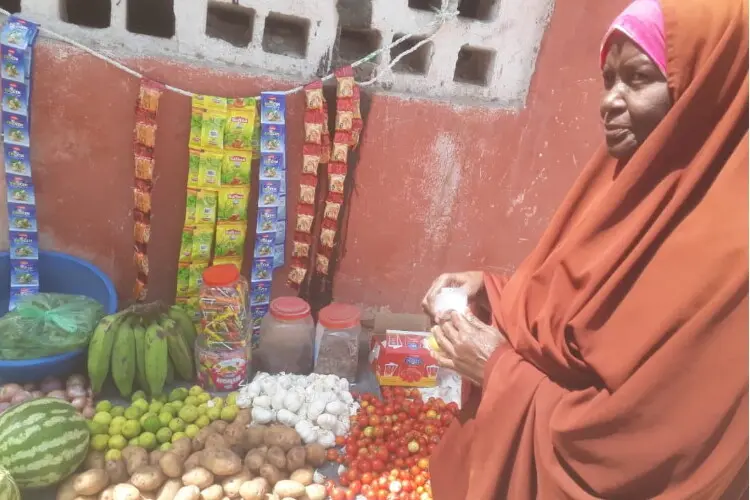
Hodan Mohamed Abdi also put her Bahnano cash grant to good use, opening a stall selling a mix of items in Kaam-Qorah displacement camp. She carefully planned how to turn the money into a steady income source.
Supporting a family of eight, Hodan said her household’s situation changed after she began earning $6-7 daily profits from her small business.
“Vegetables sell differently each day – sometimes for $5, sometimes $6 or $7,” she said. “I used the $360 to open a vegetable table and also to sell small goods like sweets, biscuits, shampoo, and soap. I paid off $160 in debt, used $140 to buy shop items, and spent $60 on vegetables.”
Hodan buys vegetables in bulk from Dhobley town and resells them in smaller quantities to camp residents. She can now provide her children with three meals a day.
“There is a big difference between a parent who puts food on the fire for their children and one who goes to the market and comes back empty-handed,” she said. “Someone cooking rice and beans for their children is not the same as someone who searched for work all day and found nothing.”
“I hope my business grows,” she said. “For now, it is small, but I want it to sustain us better. I have no husband. I rely on this work alone to support my family.”
Hodan and her family were displaced in 2022 from Sakow district in Middle Juba, where they were farmers. Drought destroyed their crops, forcing them to seek refuge in displacement camps in Dhobley.
The Bahnano programme is run by the Somali government with funding from the World Bank. The cash payments in Dhobley were managed and distributed by the Norwegian Refugee Council (NRC) and World Relief and Rehabilitation Services (WRRS).
The chairman of Dhobley’s displacement camps, Mohamed Wadi Mohamed, told Radio Ergo that the cash programme had a positive impact on many families’ lives, though needs remained high.
He estimated that 150 of the Bahnano cash recipients had set up businesses, enhancing their prospects of making a sustainable living.
“People are not the same – some used the money to clear debts and meet urgent needs. Others invested it by buying two or three goats, or opening small businesses. Many people managed to build something from it,” he said.
He added that those who received the cash were selected based on vulnerability and family size, whilst the registration was handled independently to prevent manipulation or favouritism.