Radio Ergo - Somali Humanitarian News and Information
  • Home
  • Topics
    • Latest Stories
    • IDPS/Refugees
    • Natural Disasters
    • Health
    • Social
    • Food Security
    • Education
    • Agriculture & Livestock
  • Programmes
    • Locust Programme
    • Farming Programme
    • Radio Doctor Programme
    • Women Programme
    • Entertainment Programme
  • About Radio Ergo
  • Contact Us
  • blankSomali
  • blankEnglish
No Result
View All Result
Radio Ergo - Somali Humanitarian News and Information
  • Home
  • Topics
    • Latest Stories
    • IDPS/Refugees
    • Natural Disasters
    • Health
    • Social
    • Food Security
    • Education
    • Agriculture & Livestock
  • Programmes
    • Locust Programme
    • Farming Programme
    • Radio Doctor Programme
    • Women Programme
    • Entertainment Programme
  • About Radio Ergo
  • Contact Us
  • blankSomali
  • blankEnglish
No Result
View All Result
Radio Ergo - Somali Humanitarian News and Information
Home AGRICULTURE & LIVESTOCK

Women from drought-hit Bakool village trek to find building work

Radio Ergo by Radio Ergo
October 8, 2025
in AGRICULTURE & LIVESTOCK, FOOD SECURITY, LATEST STORIES
0
Women from drought-hit Bakool village trek to find building work

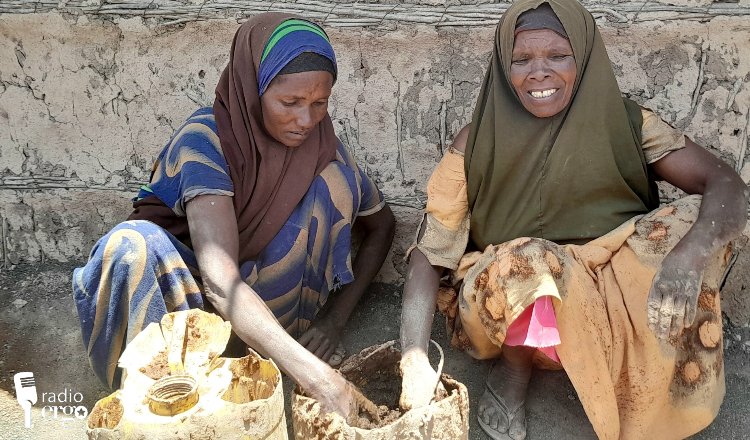
Baarey (right) and another woman from her village mix mud and dung for house plastering/Mohamud Abdirashid/Ergo

0
SHARES
Share on FacebookShare on Twitter

(ERGO) – Women in the drought-stricken farming village of Arshale, in southern Somalia’s Bakool region close to the border with Ethiopia, are spending days away from their children as they move to find work in traditional housebuilding in another town.

Bareey Ali Ahmed, 46, walks 40 kilometres from Arshale to Washaaqo each week to work with all-women teams doing house plastering.

As the agricultural work on the land in her village shrank away, this tough has given her a way to provide two meals a day for her family.

“I have no livestock, and the farms have dried up, that’s why I come here to work. We spend five or six nights here, and when we earn something, we return home and stay two nights before coming back again. We walk six hours from early morning until we arrive, because we have no vehicles. Whatever God grants us from this mud work, we take it home to support our children,” she said.

Bareey said that the long treks and heavy work are exhausting, but she has no choice. She earns $20-25 a week, which helps her family of eight children enormously.

Arshale lies in a dry, semi-arid area in Tiyeglow district, where most residents depend on small-scale farming and livestock for survival. The land is dusty and harsh, with little vegetation and scarce access to water.

Repeated droughts have wiped out crops and animals, leaving families without income or food. With no local work opportunities.

Bareey is among around 50 women walking weekly to Washaaqo to work. She used to make $90 a month working on a seven-hectare farm near Arshale, planting, watering, and guarding crops. The farm owner also supported her with portions of the harvest, including maize and vegetables. However, drought destroyed the crops.

The house plastering work is the only alternative she could find.

“With this job I can buy shoes for my children, sugar, and other food. I make sure they eat at least once or twice a day. Life is better now compared to before, when there was no work at all. Farming used to provide some income during the rainy seasons, but when the rains failed, we had nothing,” she said.

She only sees her five-month-old baby one day a week, as she spends the rest of the week in Washaaqo. Her elderly husband, unable to work, stays at home with the children.

The women work in groups collecting mud and mixing it with livestock dung to plaster walls, sharing the workload and the hardships of the long trek.

Dahabo Aadan Sulayman, a 60-year-old widow and mother of nine, was interviewed by Radio Ergo’s local reporter while she was working plastering a traditional hut made of mud and dung. She explained that local builders contacted her whenever work was available.

“The day we work, I earn about $20. With that, I can provide at least one meal a day for my children. Sometimes it covers both lunch and dinner. This is how we survive,” she said.

Dahabo previously relied on farm work. She has a debt of $300 that she worries about.

“I borrowed this money just to give my children food and clothes, but now I cannot repay it. Each time I come back from work, I find my children hungry. How can I pay the debt when even food is a struggle?” she asked.

Eedagow Mohamed Mahmoud, 49, added that her family of six children under the age of 10 had been struggling since farm work disappeared due to the drought.

“We used to get a share from farming, but when the rains stopped there was nothing. We had to leave and come here to Washaaqo to do house plastering or laundry to get a little money to buy food. If we earn enough, I cook twice a day for the children. If not, just once,” she said.
Previous Post

Farmers in remote Sool valley in crisis due to drought and crop pests

Next Post

Radio Ergo audience feedback report 2-8 October 2025

Related Posts

School closes as UNICEF cuts funding leaving IDP children in Baidoa out of education
EDUCATION

Schools close across Galmudug due to drought

April 14, 2026
Drought-hit Lower Juba pastoralists flee towards the Somali-Kenyan border
IDPS/REFUGEES

Drought-hit Lower Juba pastoralists flee towards the Somali-Kenyan border

April 13, 2026
Low income Hargeisa families forced into IDP camp due to rising prices and shrinking income
FOOD SECURITY

Low income Hargeisa families forced into IDP camp due to rising prices and shrinking income

April 10, 2026
Somalia live news, Somalia latest news, Mogadishu live news, Somali news
FF Feedback

Radio Ergo audience feedback report 2-8 April 2026

April 9, 2026
Human fallout from conflict in South West state – thousands of families displaced and struggling
FOOD SECURITY

Human fallout from conflict in South West state – thousands of families displaced and struggling

April 8, 2026
High prices of water cause health and hygiene problems in Mogadishu IDP camps
FOOD SECURITY

High prices of water cause health and hygiene problems in Mogadishu IDP camps

April 6, 2026
Next Post
Somalia live news, Somalia latest news, Mogadishu live news, Somali news

Radio Ergo audience feedback report 2-8 October 2025

FOLLOW US ON FACEBOOK

DAILY PROGRAMMES

IDAACADDA 15-APR-2026

IDAACADDA 15-APR-2026 by Radio Ergo

IDAACADDA 15-APR-2026
Episode play icon
IDAACADDA 15-APR-2026
April 15, 2026
Episode play icon
IDAACADDA 14-APR-2026
April 14, 2026
Episode play icon
IDAACADDA 13-APR-2026
April 13, 2026
Episode play icon
IDAACADDA 12-APR-2026
April 12, 2026
Episode play icon
IDAACADDA 11-APR-2026
April 11, 2026
Search Results placeholder
Radio Ergo Weekly Newsletter
We respect your privacy.
blank
blank
blank

© Copyright 2014 - 2024 Radio Ergo

No Result
View All Result
  • Home
  • Topics
    • Latest Stories
    • IDPS/Refugees
    • Natural Disasters
    • Health
    • Social
    • Food Security
    • Education
    • Agriculture & Livestock
  • Programmes
    • Locust Programme
    • Farming Programme
    • Radio Doctor Programme
    • Women Programme
    • Entertainment Programme
  • About Radio Ergo
  • Contact Us
  • blankSomali
  • blankEnglish

© Copyright 2014 - 2024 Radio Ergo