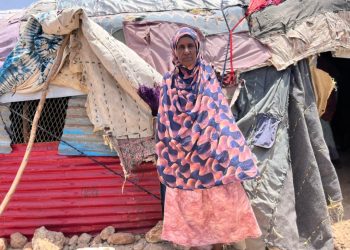


(ERGO) – Pastoralist mother, Hawo Ahmed Ali, has turned her hand to farm labour near Galkayo in central Somalia’s Mudug region, after her family lost their livestock to drought and fell on hard times.
She is working on a five-hectare plot in Lasa-adale, planting and cultivating crops and protecting the farm from animals. They had been reduced to eating once a day with food from relatives or taken on credit from shops. The farmwork is tiring but her family depends on her.
“We went through droughts, then a prolonged dry season, then a slight setback. We went through a very difficult life, but now we are living well, and my spirits are good, even though I am a bit weak and can’t work as hard, and my body is trying to catch up and adapt,” she told Radio Ergo.
Her $150 per month wage supports her eight children and 75-year-old husband, who is unable to work due to bone tuberculosis.
“My family’s current situation is moderate. We are living off this job, and we are satisfied. The children are getting their food. When I receive that money, I buy food, pay for some with medicines, and we get whatever we need to eat.”
She has paid off $100 of the $1,500 debt they accumulated over nearly three tough years. She is relieved to be no longer chased by shopkeepers but paying off the whole debt will take time.
She is among 375 people from families who lost their livestock due to drought now working on farms in the areas of Lasa-adale, Harhar, and Boran-aadka in Mudug region. They set up their own association earlier this year.
Hawo’s family lost 100 goats and 25 camels – their entire livelihood- during the drought in 2021. They were forced to move to the town where relatives helped them with three makeshift huts they now occupy.
Mudug region traditionally had few farms, as most people lived from pastoralism. However, various initiatives have encouraged people to diversify into farming. These include a World Food Programme project earlier this year that provided solar panels and farm tools. Those farmers who were helped to set up are now able to provide work for others.
Mahamed Nur Mahamed has been working since March on a farm in Harhar, growing and guarding vegetables. His job supports his elderly mother, his wife, and six children.
He found relief from the constant worry about their daily living. They now cook twice or three times a day.
“I didn’t have any other knowledge or skill in the town to survive and earn income. Whatever I earn monthly since starting this farm work provides for my family now,” he said.
He brings a container of milk for his sick mother every day after work, as she can’t eat anything else. The $150 he earns a month covers his family’s food, $15 school fees for three of his children, and small repayments towards his $1,200 debt.
Since their 150 goats and 40 camels were wiped out by drought and disease in 2021, he had been making a dollar or two from odd jobs such as stone breaking.
“There is a huge difference between when the family was in need and I didn’t have a job or anything to bring for them to eat compared to now. Before I got this job, I used to go out every morning. I’d bring back anything for food but often I didn’t find anything and went home empty handed. My
worry was about the children needing school and me not being able to provide basic necessities, and the month ending without any income. Now we are better,” Mahamed said.
A similar story is told by Kheyre Ibrahim Abdi, who started a job on a private farm in Harhar in February, growing watermelons, sweet limes, grapes, cantaloupes, bell peppers, chilli peppers, and tomatoes. He earns $150 a month, which has been sufficient for food, water, and two of his three children’s education.
“My family is in a good situation now that I am working on the farms of Mudug. Things are 100 percent better. It’s far better having a job as I’m contributing to productivity as well as earning income and making a living,” Kheyre said.