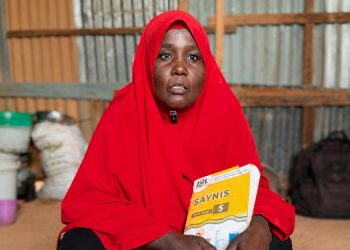


Mother of nine, Madino Ibrahim Hasan, a seasoned farmer with 23 years’ experience, is confronting the harsh realities of food shortage and homelessness for the first time, as severe drought hit their farm in southern Somalia’s Bay region.
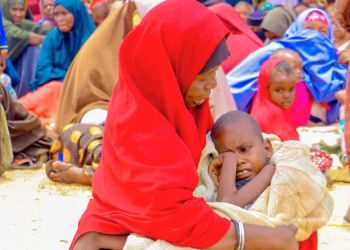
She has sought refuge at Buulo-keerow camp on the outskirts of Baidoa, where around 200 families including a mix of farmers and pastoralists are living after fleeing their homes in drought-stricken parts of the region like Goof-gaduud, Shabeelow, and El-doon.
Madino and her family arrived in the camp in June after a devastating drought wiped out their promising harvest from their four-hectare farm in Goof-gaduud.
To provide for her children, she walks 5 kilometres every morning to gather firewood, which she sells for $1 to $1.50. Unfortunately, this income is barely enough to sustain her family.
“We are facing hardship now. Our farms dried up, and we had to leave them. Here, I survive by carrying firewood on my back, which doesn’t provide a decent livelihood. Some nights we get food and others we sleep hungry. I have nothing, and my children are orphans,” she told Radio Ergo.
Madino said it took her two days to walk from Goof-gaduud, 30 kilometres from Baidoa, to reach the camp with her children. She left behind their two-room mud house and belongings as she couldn’t afford transport to move their belongings.
They have no regular food and no proper shelter. She keeps her children in a makeshift hut made of tree branches and plastic sheets, which offers them little protection.
Disappointed by the living conditions, she reflects on her lost hopes of making $1,000-$1,500 from her farm this year. Instead, she lost $300 worth of seeds due to the severe drought.
Following the death of her husband, who worked on their farm, she has been unable to cultivate during the past two rainy seasons. She also worries about repaying a $250 debt incurred to feed her children.
“We had no water, and after two years of drought, we had to flee. Now, I leave everything to God. I keep asking those who gave me the loans for patience, telling them I will pay when God provides, and that’s how I manage,” she said.
The struggle for survival has been overwhelming for them, affecting all aspects of their lives. Four of Madino’s children, who were previously in school, had to drop out of their studies
Similarly, Aadan Abdirahman Salad, who settled in the camp with his family of six in early July, noted that food is critically scarce. His family survives on minimal rations, often receiving assistance from neighbours, and some nights going to bed hungry without help.
“Our life is in a critical state, and I fear that if this continues, it will be too much for my children and my wife. Our house is made of plastic bags and cartons and if it rains at night, we are in trouble,” Aadan said.
Aadan and his family fled from El-doon after their livestock including 150 goats and five cows died in the drought. Their loss has left them without a sustainable livelihood.
Accessing clean water is another pressing concern in the camp. He explained that they must travel two kilometres to fetch water from a well, where they pay 5,000 Somali shillings per jerrycan. When they have no money, they return empty-handed, as the well owners do not give credit.
After arriving at the camp, Aadan attempted to find work in construction but faced difficulties due to unfamiliarity with the area and few job opportunities.
“I am extremely worried because I have no job. I have been working in construction, but for the past two months, I haven’t found any work because the people I worked for are no longer around,” he explained.
Aadan said he regrets his decision to come to the camp, as he had hoped to receive assistance there but none has come. His children have also fallen ill in the camp, and he fears they have contracted unknown diseases spreading in the unsanitary and crowded camp.
The chairman of Buulo-Keerow camp, Osman Kerow Hassan, said new arrivals are coming to the camp every day. He explained that they are doing their best to accommodate them, although the camp is getting crowded. Both new and long-time residents of the camp are facing the same dire living conditions.
“The camp houses 200 families. Some have been here for 10 days, some including a single mother arrived yesterday. The camp lacks water, food, and toilets. Since its establishment, nothing has been provided for a single day.
I am appealing to humanitarian organisations, the South West State administration, and the federal government to urgently assist these people,” the camp leader told Radio Ergo.