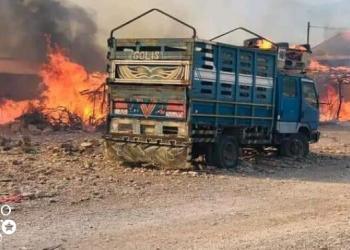


(ERGO) – Hundreds of families have been forced to abandon their homes, property and jobs in Herale district in central Somalia’s Galgadud region where clan conflict over resources has caused chaos.
Most of these families are pastoralists, who left behind their livestock and small businesses as they fled from the villages of Jabsiile, Qalanqale, and Landher, seeking refuge in the village of Mirjiley.
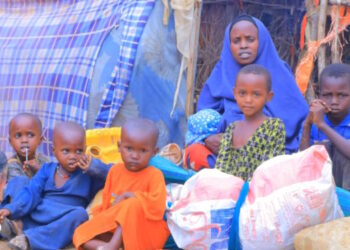
Deqo Mohamed Ibrahim eventually reached Mirjiley on 22 September after her family walked for 12 hours because they couldn’t afford transport. They left behind their house, belongings they couldn’t carry, and the 10 goats they relied on for food.
“When the fighting broke out, it was unexpected. We were just lying down early in the morning when the gunfire erupted. The intensity was so overwhelming that we couldn’t even figure out where to run,” Deqo recalled.
“Eventually, we fled into the wilderness. Some families became separated, with parents and children losing track of each other in the chaos.”
Her husband worked on construction sites to supplement their income. In Mirjiley, empty handed, they are forced to ask neighbours to share them what little that can spare. There’s no food at home. Whatever we eat for the day is given to us by a local family, sometimes cooked, sometimes raw. We don’t have a reliable source. When someone gives us a few kilograms of food, we use it sparingly. On a good day, we cook only once in the evening, which is difficult especially for the children,” Deqo said.
Having fled with only the clothes on their backs, Deqo and her eight children are sleeping outdoors, seeking shade under trees during the day and shivering at night. Her biggest concern is the uncertainty of how long they can endure this, with no end in sight to the conflict.
More than 700 families have arrived in Mirjiley, running away from the battles between clans raging around their homes. All are relying now on other locals who live from pastoralism.
Nasteho Ali Isse said that while her family had received 36 kilograms of flour, rice, and sugar collected by the community in Mirjiley, they were fast running out of food.
“We came here only for safety from the violence, but we have nothing here. We are faced with hardships, and although the people have been kind to us, it’s not enough. We didn’t bring food, and even before the conflict, we had little in reserve,” Nasteho explained.
She described the struggles her 10 children face living in a makeshift structure made from sticks and cloth. She feared the approaching rainy season, as their shelter will not withstand the downpours.
Although Mirjiley is just 12 kilometres from where they were living in Landher, Nasteho’s family had to walk for more than 16 hours, taking a much longer route to avoid the dangers of the fighting.
Her four children, who were studying Koranic classes at home, are now out of school, adding to the family’s instability.
Access to water is challenging. Nasteho walks 30 minutes to fetch water from a crowded water well. Although the water is free, the amount she can carry back is far too little for her family’s daily needs.
“I carry a 20-litre container and a smaller 5-litre one, but even then the water doesn’t last us the day. If only our village were safe, I would go back immediately. I don’t belong here, and we have nothing here,” she told Radio Ergo.
Nasteho’s family have experienced nothing but crisis in the past several years.
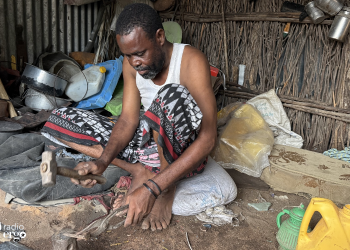
In 2021, they moved to Landher from the rural areas after severe drought killed most of their livestock. Since then, they relied on her husband’s labour, breaking quarry stones for a living.
The recent violence, sparked by disputes over grazing land, caught the area off guard during a dry season when resources were already limited.
The head of social affairs in Mirjiley, Mursal Hirsi Abdi, confirmed the urgency of the situation.
“We have submitted multiple reports on the displaced families’ needs. The director of the Galmudug relief ministry visited, but so far we’ve received no aid,” he said.
Mursal noted that land disputes over wells, grazing fields, and other resources often led to cycles of violence, intensified by the availability of weapons among clans. For local authorities, this makes conflict management challenging.
“Land, wells, and grazing areas are common causes of these clashes, which have taken countless lives and assets. Clans often have more power than the local administration, making conflict resolution difficult,” he told Radio Ergo.