(ERGO) – Farming families in Dhardhar village in central Somalia’s Mudug region have run out of food following the loss of their harvests during flash flooding late last year.
The local farmers’ association says 51 of its members are in difficulty and cannot support their families after using up their remaining food reserves.
The flash flooding last November, following abnormally heavy rainfall, came in the wake of four years of harsh drought in the area that led to repeated crop failure and poor production.
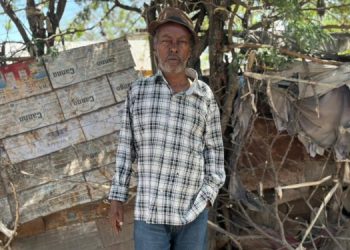
One of the families affected is Abdi Isse Ereg and his wife and 11 children, whose three-hectare farm in Dhardhar village, about 70 km southwest of Galkayo, had nothing left after the floods. They had planted their crops last September and were set to harvest at the beginning of this year.
With no other income, Abdi now depends for support on his relatives in Bandiradley, the nearest town five kilometres away. They are eking out what little food they are given sparingly.
He had resumed farming after the prolonged drought and was hoping to make a decent income from his farm to pay off his debts and cover his family’s needs.
“You can imagine someone who had planted crops and they all failed. I had high hopes of making a stable income and improving our lives, but it didn’t happen,” he said disappointedly.
They used up the small amount of grain and maize they had stored from the previous ‘gu rainy season and can no longer get anything on credit from local shops in Bandiradley, as the business owners know the harvests failed and the farmers can’t repay.
“The business people want their money and I had been telling them to wait until I got the harvest, but instead I lost everything,” said Abdi, who worries about the $1,500 loans he took for planting.
Abdi planned to switch to pastoralism whenever his farm was not productive, but the prolonged drought also took a heavy toll on his livestock. He has only 12 goats that survived the drought, but the young and feeble animals don’t meet the local market standards.
Similar distress faces Hassan Adan Hashi and his wife and eight children, whose four-hectare farm was ruined in the flash floods.
“It has affected us and we are now impoverished people. We even bought fences for our farm and hired a vehicle to carry the farm supplies. Our crops were all washed away and we have suffered big losses,” Hassan told Radio Ergo.
He was hoping to make $2,000-$3,000 profit from his harvest. His immediate family and families of his relatives, who worked on the farm and shared a portion of the harvests, have nowhere to turn.
Their food reserves ran out in February.
To make ends meet, Hassan has taken labour jobs on construction sites in Bandiradley. Once or twice a week he gets a job for a daily wage of about seven dollars. This is too little to cover their needs, so his family eats one meal a day.
“This job is hard but we need it since I have got responsibilities. I go to work early in the morning and work till midday. Works isn’t always available because there aren’t many construction sites,” he said.
Hassan took $1,700 in loans from businesspeople in Garowe and Bandiradley over the past two years and has no means of repayment.
The chairman of the farmers’ association in Dhardhar, Abdirashid Mohamed Hersi, said the local farmers hadn’t had successful harvests for four years due to recurring droughts. Last year’s heavy rainfall was welcomed at first, but then it turned to flooding and major losses all round.
“The farmers were striving to work on their farms although they had limited capacities. These people didn’t have the right equipment or ways of controlling the floodwater, so they were hit hard,” he said.
He said some farmers had been trying to connect pipes from a borehole 12 km from their village, but they couldn’t raise enough money for the installation. He added that the farmers’ association had no capacity to stave off the uncertainty facing the farmers, whose situation was worrying.