

(ERGO) – Mahmoud Abdi Makooma is enjoying a new sense of stability from his farming in Qaam-qaam in Somalia’s Lower Juba region, since the opening of an irrigation canal this year.
Mahmoud has earned $1,100 selling the crops he harvested in October to customers in Kismayo, Qaam-qaam, and nearby villages.
“We were under a lot of pressure, but now we are doing well,” he said, referring to the last three troubled years of drought.
We used to go to the market without buying anything, but now the farm gives us income. When we go to the market, we can buy meat or beans. We are living well!”
The farming community in Qaam-qaam has weathered failed rains, acute water shortage, as well as periodic river floods, and pest invasions.
This year, though, Mahmoud harvested 70 kg of tomatoes, 100 kg of watermelon, and 18 sacks of maize. He also sold 90 pieces of watermelons as well as lettuce, coriander, okra, peanuts and cantaloupes.
His village is far from the river and dependent on erratic rainfall. The irrigation canal has enabled reliable access to water beyond the rainy seasons.
“We didn’t have a pump and couldn’t afford one. We only farmed during the Gu’ rains. The rest of the time, we had no water so we stopped farming. We could only plant maize. Now I can plant anything, it makes a big difference,” he said.
He supports his 18-member family, reinvests part of the income into the farm, and has saved $160. With seeds from the UN’s food security agency, FAO, he diversified crops planted on his eight-hectare farm.
Having survived on two to three dollars doing casual farm labour in surrounding villages, Mahmoud proudly enrolled five of his children in Koranic classes and a centre teaching Arabic and English in November. He paid the $60 school fees, repaid $375 of his debts, and plans to clear the remaining $600 after selling his next harvest.
The new irrigation system has been built by the German government agency GIZ, working with Norwegian Refugee Council and the Jubbaland Ministry of Agriculture.
The canal is 1.5 km long, took three months to build, and cost over $1.5 million. Powered by 54 solar panels, it pumps more than 1,000 barrels of water a day from the river, supplying consistent irrigation so far to 110 local farmers.
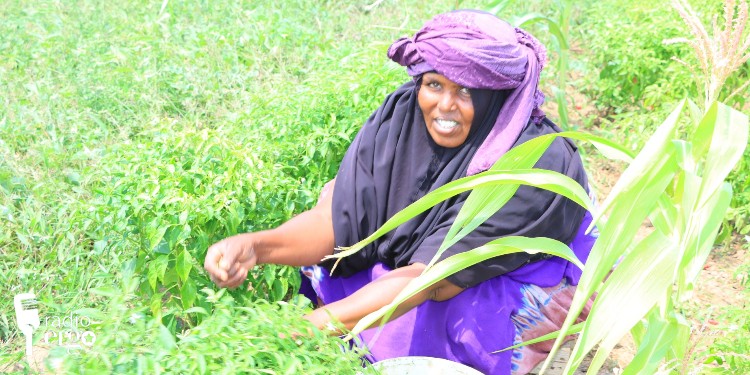
For Saynab Mohamed Yusuf, the harvest of maize and vegetables from her seven-hectare farm in October was a blessing.
“Pipes bring water from the river through the solar system. A tank and small reservoir were built inside my farm. One pipe supplies my farm and another goes to people further away. Everyone gets a turn,” she explained.
Saynab earned $800 from the sale of vegetables, maize, and sorghum, and stored eight sacks out of 20 as a reserve. She reinvested $250 ino the farm and expects to make around $500 when the next crops mature.
Saynab and her husband manage the farm with the help of two labourers they pay $4 per day. The improved returns have eased pressure on her family of 10.
She repaid $200 owed to food shops in Qaam-qaam and pays the $28 monthly for her four children in primary school that her brother in Kismayo had been covering for her.
Saynab described five years of struggle and setbacks, when her family survived on about two dollars a day earned from firewood that her husband collected and she sold.
They had invested in a water pump and seeds, only to lose $380 when pests destroyed onions and tomatoes and they couldn’t access river water due to the distance from their land. The 10 litres of fuel they bought ran the pump for only six hours, irrigating just two hectares.
The chairman of Qaam-qaam farmers’ cooperative, Omar Yusuf, said the farmers selected to benefit first from the irrigation canal were among those most in need out of more than 300 farmers in the area.
“This is the beginning of progress – it has greatly improved their lives. They planted vegetables and maize. Everyone earned according to their capacity. It’s now a place busy with daily work, whereas before they only farmed for three months during rainy seasons. Now they can farm all year,” he said.
The Jubbaland government and the project funders are discussing expansion of this irrigation support to serve a wider area.