

(ERGO) – Single mother of nine, Fadumo Haji Hasan, had to scramble for her life to cram her children into the vehicle transporting them hurriedly out of their village of Galad, when it became the centre of an active conflict zone in central Somalia.
Her small herd of 18 goats – the last few that survived the drought in this part of Galmudug region – couldn’t fit into the truck and were not able to walk the 80 kilometres to El-dher town.
So, she abandoned them in the village, fleeing in September just with the children and a handful of belongings.
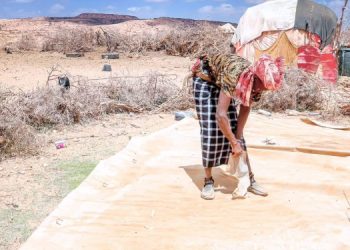
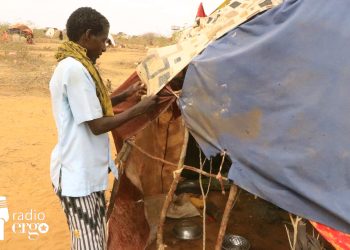
Fadumo and her children have joined dozens of other families escaping the conflict between Somali government forces and Al-Shabab, who have thrown together feeble shelters made of sticks and cloth on an open, windblown land outside El-dher.
Two of her children are unable to walk due to a neurological condition diagnosed 18 months ago. Fadumo said their condition has worsened due to the hardship and hunger, and they now lie helplessly on the ground, having no access to treatment or support.
“You can imagine what it’s like for me as a mother raising children alone, with no father beside me and no older son to support the family. I have nothing, and their lives depend on whatever God makes available through other Muslims. My children are sick. We are living in a state of great hardship and suffering,” Fadumo told Radio Ergo’s local reporter in an emotional phone interview.
At least 480 families have been displaced to El-dher from Galad, Qodhiley, El-Haji, and Cows-weyne villages since the war escalated in this area.
But the military might, including US airstrikes targeting Al-Shabab in support of the Somali government forces, has obscured the desperation of these civilians, who remain powerless and almost invisible pawns in the war.
“The situation we are living in, only God knows. The few people who are better off give us a bowl of food. When we get something, we cook; when we don’t, we stay hungry,” Fadumo said.
We are in a conflict zone, and there’s nowhere to get even the bare minimum.”
She walks four kilometres with her 10-year-old daughter to a well to fetch a jerrycan of water a day. The long trudge in the heat drains them, but she can’t afford the cost of $0.20 per jerrycan charged by the commercial water truckers.
She is unable to access credit from local shops and businesses as she is new to the area and not known to people.
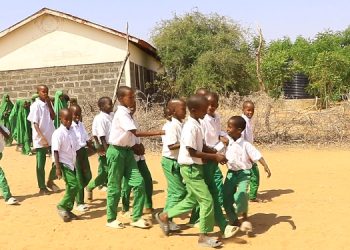
Fadumo’s three school-aged children attended Koranic classes in Galad, where she paid $6 a month for all of them. She can’t afford the schools in El-dher. Shopkeepers at home are chasing her to repay her debts of $500 that she bears as another burden of anxiety.
Also camping in the barren area outside El-dher is Saredo Muhudin Ahmed, whose family of eight walked for two days and nights to reach the settlement, a trek of nearly 40 kilometres from El-Haji village.
The 10 goats they brought with them no longer produce milk as they are thin and in poor condition from the journey. Due to the impact of the drought in the district, they had already lost 90 goats.
“Our shelter here is just branches and pieces of cloth we have put together. If it rains, the water comes in. If strong winds blow, it collapses. At night, when we want to sleep, we huddle together. The place we live in is open land with strong winds and cold,” Saredo said.
Her husband makes a couple of dollars unloading goods from vehicles in El-dher, but the work is sporadic as well as physically demanding for an older man. Saredo walks to El-dher daily in search of cleaning work, but hasn’t found any.
Her children are constantly sick with fever and coughing but there is no health centre in the settlement and taking them to town for treatment would be costly.
“We don’t even have money to pay for a painkiller injection,” Saredo said despairingly.
Three of her children attended Koranic school in El-Haji costing $5 a month for all of them. Schools in El-dher charge that amount for each child, which is impossible for her.
The deputy commissioner for security and politics in El-dher, Daud Abdullahi, said they had registered 480 displaced families arriving in the settlement since September.
They face severe resource shortages and the scale of need is far beyond what the local community can meet, given the toll that the drought has taken on people’s livelihoods.
“Shelter and healthcare are the biggest challenges. This is open land with no trees for shade. If an emergency occurs, there is nowhere to take someone. Apart from collecting small contributions from the local community, we are not able to help at all because of financial shortages. Due to low rainfall, farms and livestock that people depended on have disappeared,” he said.