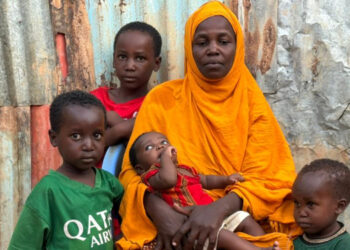


(ERGO) – The days of the humble porter – seen bent double under a heavy load on his back – are numbered in Somali markets and ports, where the use of cars and lifting machinery is taking over from manpower.
According to the porters’ cooperative in Bossaso, more than 300 porters are facing poverty and resorting to begging, after their portering jobs at the port, in markets, and at bus stations became redundant.
Mowlid Ahmed Abdi has lived off his job as a porter for 31 years. However, in March he found himself without any work at all and unable to support his large family to get even one meal a day.
“We only eat at night. We don’t have lunch or breakfast. I get that one meal by begging and going into the city to ask for a few kilos of food from people I know. There is nowhere else to get anything. It’s a situation I can’t even describe,” he said.
Mowlid’s daily earnings from portering were about $17 a day that supported his family with three meals. For the past two months, he has had one day’s work that earned him just $10.
He tried to find a cleaning job for his 16-year-old daughter, but couldn’t to help with the household expenses, but couldn’t find anything.
Mowlid is responsible for 23 children – 12 children of his own from his two wives, and 11 other children left behind by his late relatives.
He said he leaves the house every day to avoid watching his children’s suffering.
“I leave during the day so I don’t see my children and their needs. You can imagine what it’s like for me as a father when my children last ate dinner the night before, and they haven’t had breakfast or lunch, and they look at me with expectation. Necessity forces me to leave. I only come back home at night,” he said.
Three of his children were sent home from school in March after he failed to pay the $60 fees. He owes $700 in debt to shops for food and clothes he bought on credit for the last two Eid celebrations.
Since being displaced from Bula-Burde in Hiran region in 1992 during the civil war, he has never managed to save any money to fall back on.
Burhan Aweis Diriye is also struggling to provide for his family of nine, who are now lucky to eat once a day. He relies on credit from shops he frequents, but sometimes the owners deny him and the family has to go hungry.
He used to earn $50 a day from portering jobs, but now earns $2-$3 a day when he finds rare work.
“My family cooks a mixture of wheat and beans, which they eat twice a day, and they save whatever is left. Before, I used to cover all their needs, but not anymore. It was even difficult for me to provide for my children for the last Eid. Now, I am in a cycle of debt on top of debt,” he said.
Burhan was hoping to receive food aid from the UN’s World Food Programme on 10 August but was told his family was not on the registration list. His family can only afford to buy one 10-litre jerrycan of water a day, which costs $0.1.
Burhan and his family live in Girible 1 displacement in a hut made of plastic sheets and stick that was damaged by the rain in May. He can’t afford to repair it.
“We are living in a place that necessity forced me to live in, but it can’t really be called a home. You can imagine our situation living here in this hut made of rags. Before, we used to be able to build and make a nice home, but now I can’t afford to build.”
Porters are seen waiting in the city centre, at the bus stations, and outside the port of Bossaso, sitting on pieces of cardboard, hoping to get a job.
Abdilahi Mohamed Shire, 51, said he spends his days sitting on the roadside waiting for a job. He depends on relatives and friends to help him out as much as they can.
For the last 28 years he worked as a porter in the markets of Bosasso, making about $30-$40 a day. He has never learnt any other job skills.
“Men with Probox cars came to the market and are now given the transporting work we used to do. I see widespread unemployment, and there’s also extreme heat these days in the city. I have never faced this kind of destitute situation before. I used to work in the market warehouses and lived off that,” he said.
He can’t afford medicines for his elderly father, who is sick with diabetes and high blood pressure, and can’t move away I search of other work.
“I can’t leave the city and leave my father behind. Friends and relatives help us with three meals a day. Sometimes you get to carry items for one person for a dollar, but one dollar doesn’t help us at all.”
Abdilahi was displaced from Mogadishu in 1993, when the civil war forced him to leave the previous portering job he had in Bakara market.