

(ERGO) – The influx of more than 5,000 pastoralists families whose livestock died in the drought have overwhelmed the local authorities in the small town of Godinlabe, in central Somalia’s Galgadud region, and left the families themselves facing stark conditions.
The secretary of Godinlabe administration, Abdirahman Abdullahi, told Radio Ergo that having so many new arrivals over the past two months has placed immense strain on already limited resources.
“There are newly displaced families fleeing the current drought from different areas,” he said. “Their displacement is driven by the loss of livestock and livelihoods, forcing them to move closer to water points. Many of them are settling on top of existing displaced communities.”
The official said the local administration had attempted to mobilise assistance but lacked the capacity to respond to the scale of need. He warned that conditions would worsen without urgent support.
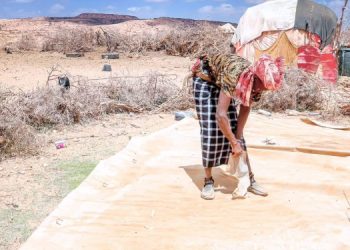
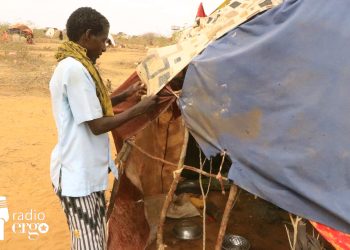
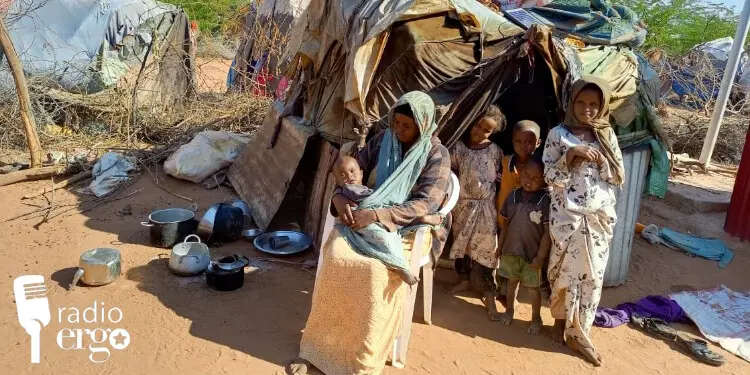
The families, who used to live off their livestock, have settled in open areas around the town, where food, water, shelter, and access to basic services are scarce.
Mahmoud Mohamed Jimale, a father of nine, says his family is facing hunger, water shortages, and homelessness since fleeing their village after the loss of their animals.
“We have been living in the open for a month now without any meaningful assistance. We cook once a day, and even that food is not enough. Some days we get nothing at all, and that has badly affected the children,” he told Radio Ergo.
The small amount of food his family receives comes from relatives living in town, who themselves are facing economic hardship. When that support fails, the children go hungry.
Mahmoud moved his family from Dhisaqa village, in Godinlabe district, after losing 50 goats to repeated failed rains. He had hoped to find casual labour or humanitarian assistance in town, but neither has materialised.
He walks daily through Godinlabe town looking for food, water, or work. His relatives can’t provide much at all and job opportunities have dried up as drought has weakened the entire local economy that depends heavily on livestock.
“I have the strength to work, but there is nowhere to work. No houses are being built, no latrines are being dug. People are just trying to survive on what little they have,” he said.
Mahmoud, 45, has spent his entire life as a pastoralist. He says his family is now facing the hardest conditions they have ever endured. With all his livestock gone and no alternative livelihood, he feels hopeless.
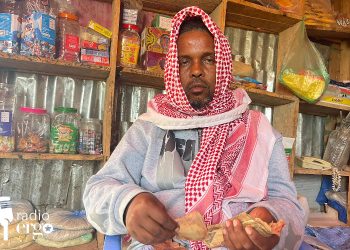
He is also burdened by debts totalling $800, accumulated over the past two years for livestock feed and household food purchased on credit from local shops. Shopkeepers are demanding repayment, but he has nothing to give them.
His children are suffering from heat-related illness after living in the open without shelter in the intense heat. They have been sick for over a week, but Mahmoud has been unable to take them to a health facility due to lack of money
After spending a month in Bari camp on the outskirts of Godinlabe, Shafi Ahmed Yassin, with a family of 11, says he cannot provide them with sufficient food, water, or shelter. The only support they get is some cooked food from relatives.
“The food we get is not enough for a family this large,” Shafi said. “On some days, the children go hungry, and that causes me constant worry.”
Shafi’s family fled Fadalawayn village, about 20 kilometres from Godinlabe, after 30 of their 70 goats died due to lack of pasture. The remaining 40 animals are severely weakened and produce no milk nor can be sold for cash.
He says one or two goats of his remaining goats are dying every day, as he has no feed to save them.
“If we don’t get food or rain this month [February], all of them will die,” he said. “That would leave us in a level of poverty I don’t know how to escape, because I have no other means of survival.”
Shafi had expected assistance upon reaching town, but so far has received nothing beyond small family donations. He was forced to leave behind his house and belongings in the village because he had no transport to carry them.
His children shelter under a tree in Bari camp with little protection from the sun or chill at night. Shafi says he has no skills outside pastoralism and no way to earn income, leaving him deeply anxious about his family’s future.
According to a recent UNHCR report, more than 8,000 other people have been displaced from villages in Adado and Harardhere districts in Galgadud due to rainfall failure. The report warns that food and water shortages are the most severe challenges facing these communities, and that limited humanitarian assistance is exacerbating the crisis.