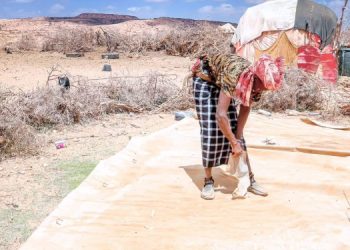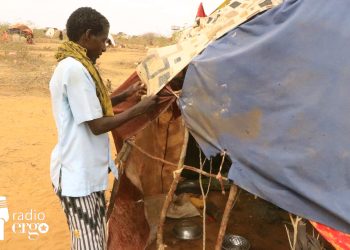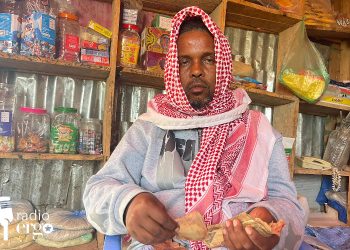


(ERGO) – Hundreds of children from rural parts of southern Somalia’s Bay region are missing out on education after their families lost their farms and animals to drought and were forced to move into displacement camps in Baidoa.
In Goof-gudud Buurey, a district around 30 kilometres from Baidoa, local leaders say that 11 village have been severely affected by the prolonged drought that has ruined crops and killed off livestock belonging to pastoralist and farming communities.
Local chief Hussein Adan said that over 20 learning centres had been closed in this area as families lost their livelihoods, affecting at least 300 primary and middle school students.
The children’s parents, many of whom lived off rain-fed agriculture and small herds of animals, say the loss of income has left them unable to afford education, which is one of their greatest concerns for the future.
Hassan Isaq Sabri, 55, told Radio Ergo that four of his children dropped out of primary and middle school in Oflow, one of the affected villages in Goof-gudud Buurey, where drought stripped them of their livelihood and forced them to move to Baidoa.
“My children had a good education before. Because of the drought that hit us, they are now without education. The school they attended closed due to the parents’ financial hardship. We are now displaced and living in a camp. I fear my children may fall into bad habits,” Hassan said.
He cannot afford the $10 per child required by private schools in Baidoa. He had hoped his children would achieve a higher level of education than he did, having grown up in a rural area without access to schooling.
But the combination of displacement, unemployment, and hunger has shattered those aspirations. He has searched unsuccessfully for casual labour jobs in Baidoa to support his family of 13 and cover school costs. Economic hardship in the city has reduced opportunities for manual work, leaving him without income.
The family relies on occasional assistance from longer-established camp residents and are sometimes lucky to find one meal a day. Hassan said his children used to eat three meals daily when they were settled back at home.
“Getting food even once a day is difficult,” he said. “We are new here and do not know many people. Sometimes neighbours allow us to cook with them. Before, the children were well-fed. Now we have nothing.”
The family borrows 20 litres of water a day from neighbours because they can’t afford the 5,000 Somali shillings charged per barrel at a nearby private borehole. At night, the children sleep in huts belonging to other families, while the adults stay outdoors.
Hassan was a farmer who owned four hectares of rain-fed land in Oflow. Two consecutive failed rainy seasons wiped out his crops, costing him $350 in seeds alone. At the same time, 32 goats died due to lack of pasture and unfamiliar diseases.
“All our sources of income are gone. This is the hardest life we have ever faced,” he stated.
Another displaced parent, Ali Malin Hasan, has five children who have also been out of school since December. They had been in school in Arag village, where he paid a combined $30 per month in fees.
“People fled the village, and the teachers left. The school simply closed,” he said. “I cannot afford to continue their education. Their lack of schooling causes me deep distress.”
Ali’s family of 12 now lives in El-bay 1 IDP camp near Baidoa, where there are no schools. The nearest private schools charge about $50 per month. He worries that his children, who once showed strong academic potential, will forget what they learned.
“They feel discouraged when they see other children their age going to school,” he said.
The family survives on a single kilogram of food per day, which his wife obtains through begging in the city. Sometimes they go to bed hungry.
They left the rural village after their three-hectare farm failed. Crops including maize, beans, sorghum, sesame, tomatoes, and peppers planted last April dried up due to drought and pest infestation. Ali says he lost around $400 he had borrowed and invested in seeds and inputs.
The family left in December after exhausting their remaining food stocks from the previous harvest. They had hoped displacement would offer better conditions, but found instead severe food shortages.
The chairman of El-bay camp, Mohamed Aadan Ibrahim, said nearly 500 newly arrived families with school-aged children had been registered since December.
“The children have no access to education. There are no schools in the camp, and parents cannot afford private ones,” he said, adding:
“Families are facing water shortages, hunger, lack of shelter, and poor health. We have no capacity to change their situation. We appeal to aid agencies and authorities to respond.”