(ERGO) – Thousands of newly displaced families in Bardera district of Gedo region are acutely short of food, water, and shelter, having fled prolonged drought that has devastated their livelihoods in the countryside.
More than 5,700 families have arrived in and around Bardera town since December, driven from their rural homes by four consecutive failed rainy seasons that wiped out livestock and other sources of income. Many are now living in overcrowded camps with little or no access to basic services, relying on irregular support from host communities.
Among them is Zaynab Jamad Ali, arrived in Bardera with her seven children and husband.
“We are living in a very difficult situation. In the mornings we cook whatever we beg from people. We have nothing of our own to depend on. Life is extremely hard,” she said.
They occasionally receive small amounts of food from neighbouring families in Iftiin camp, but it is not enough to feed the household. She has been unable to find casual work in town, citing the lack of opportunities and the high number of women competing for the same jobs.
Her husband is elderly and visually impaired, leaving her as the sole provider for the family. With young children who can’t work, the burden of survival has fallen entirely on her shoulders.
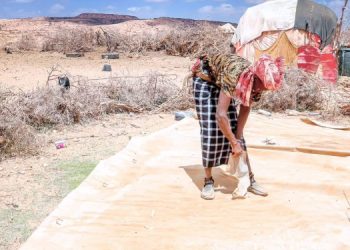
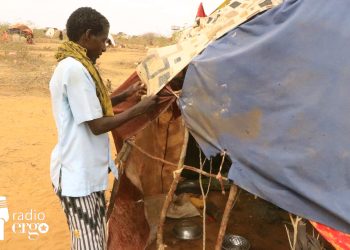
Without proper shelter, they are living under trees covered with pieces of cloth, offering little protection.
“We are homeless and that is our biggest problem now. We are staying under trees with old rags. We cannot afford plastic sheets to build a shelter, and no one has given us anything,” she said.
Two of Zaynab’s children have dropped out of Koranic school since their displacement. She used to pay around $10 a month for their classes but she can’t afford it now.
She also has debts of around 10 million Somali shillings ($400), owed to shops and water sources in her home area. The constant demands for repayment are a source of stress, as she has no means to pay.
Like many others in the camps, her family were pastoralists who lost their livestock to drought. Since 2024, they have lost around 70 animals including goats and cattle. She left 10 animals that survived the drought with relatives still in the rural village – although she does not expect them to survive due to ongoing water and pasture shortages.
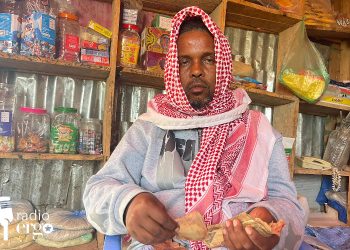
Hussein Hassan Mooge, a 66-year-old father of 10, said his family is also struggling to meet their basic needs in Jirih camp, where they settled in December.
“The biggest problem is hunger,” he said. “If people had enough food, they could manage the rest. But when you are hungry, you cannot even rest.”
Hussein spends his days walking into town in search of assistance from relatives or local traders. On some days, he manages to bring back enough to cook one meal, but often the family goes without food.

Access to water is another major challenge. They rely on water fetched from the Jubba River by his wife, as they can’t afford to buy water from nearby private reservoirs, where a 20-litre container costs about $0.3.
The sprawling camps lacks health and education services. Two of Hussein’s children have recently suffered from fever and persistent coughs, but he cannot afford medical care: “We have no money to take them to a health facility. We just stay and hope they get better.”
Like Zaynab, Hussein has no alternative source of income. He has spent his life as a pastoralist and lacks the skills to find work in town. Despite repeated attempts, he has been unable to secure even basic labour jobs.
His family is also burdened by debts of around $300, accumulated from food, water, and other expenses. Four of his children have dropped out of Koranic school after he failed to pay $7 per child in monthly fees for six months.
The drought has taken a heavy toll on his livestock. He lost 287 animals, including camels, goats, and cattle, leaving him with just 11 goats that are too weak to provide milk or income.
The situation facing these families reflects a broader crisis affecting pastoralist communities across southern Somalia, where prolonged drought and climate shocks have forced thousands to abandon their traditional way of life.
Mohamed Hussein Boyow, an awareness officer with Jubbaland state’s agency for displaced people, said the scale of need in Bardera is overwhelming.
“The condition of the newly displaced families is extremely serious,” he told Radio Ergo. “They lack shelter, food, water, and access to health services. Some cannot even cook one meal a day.”
He said local authorities and communities had tried to mobilise assistance, but the support available was far from sufficient given the growing number of arrivals.
According to his office, 5,733 families displaced by drought from parts of Bay and Gedo regions have been registered in Bardera since December.
With limited aid, no stable income, and increasing pressure on already vulnerable host communities, many of these families face an uncertain future.