Radio Ergo - Somali Humanitarian News and Information
  • Home
  • Topics
    • Latest Stories
    • IDPS/Refugees
    • Natural Disasters
    • Health
    • Social
    • Food Security
    • Education
    • Agriculture & Livestock
  • Programmes
    • Locust Programme
    • Farming Programme
    • Radio Doctor Programme
    • Women Programme
    • Entertainment Programme
  • About Radio Ergo
  • Contact Us
  • blankSomali
  • blankEnglish
No Result
View All Result
Radio Ergo - Somali Humanitarian News and Information
  • Home
  • Topics
    • Latest Stories
    • IDPS/Refugees
    • Natural Disasters
    • Health
    • Social
    • Food Security
    • Education
    • Agriculture & Livestock
  • Programmes
    • Locust Programme
    • Farming Programme
    • Radio Doctor Programme
    • Women Programme
    • Entertainment Programme
  • About Radio Ergo
  • Contact Us
  • blankSomali
  • blankEnglish
No Result
View All Result
Radio Ergo - Somali Humanitarian News and Information
Home FOOD SECURITY

Slump in Somali shilling hits low income families

Radio Ergo by Radio Ergo
November 18, 2020
in FOOD SECURITY, LATEST STORIES, SOCIAL
0
CV19 warnings about social distancing fall on deaf ears in Galkayo

People in Galkayo ignoring social distancing advice in markets and public places/Jabril Osman/Ergo

0
SHARES
Share on FacebookShare on Twitter

Low income families in the town of Lasanod in Somaliland’s Sool region are unable to afford basic goods as prices have shot up due to high dollar exchange rates.

The inflation has led to shops and businesses refusing to accept the Somali shilling, compounding the problem for poor families who do not use the dollar-based mobile money system.

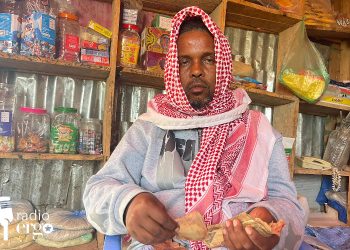
The hardest hit are daily wage earners like Mahamud Adan Ali, a father of eight, who earns 100-150,000 Somali shillings a day as a porter loading and unloading cargo trucks. His small income used to be just enough to cover the needs of his family, but not any longer.

“We would normally buy food and pay the rent with the money I earn, but today it is worthless. I owe rent arrears and the stores are not accepting the shilling. This is really causing us problems,” he said.

A kilo of rice now costs 35,000 Somali shillings, almost double the 18,000 price one month ago.

Mahamud has been reduced to getting food for the family on credit from a local store. But he cannot manage the $70 rent and $16 monthly school fees for his children.

The dollar that exchanged for 30,000 Somali shillings a month ago exchanges for 45,000 shillings today.

Small business owners selling meat, milk, fruit and vegetables in local markets are affected.

Fadumo Abdirahman, a single mother selling meat, has not made any sales since her suppliers refused to accept Somali shilling. She used to earn an equivalent of $5-10 a day to cater for the needs of her four children.

“My suppliers won’t accept the Somali shilling and my customers only have the shilling. This business is all I have to raise my children,” Fadumo told Radio Ergo.

She has already accumulated $250 in loans and is worried that she could be evicted from her home for failing to pay the rent.

Abdikarim Mahamud Ismail, a forex trader in Lasanod, said the inflation is caused by the scarcity of dollars and oversupply of shillings in the marketplace.

Big businessmen have been hoarding the rising dollar, and refusing to accept the shilling.

“The khat traders are the main culprits,” Abdikarim stated.

“They are prepared to pay up to 60,000 shillings for a dollar. The khat trade was not big in Lasanod before, but since the supplies from Kenya were stopped, it has been coming in large quantities from Ethiopia. This is compounded by increased amounts of shillings coming from Garowe.”
Previous Post

Health expert answers listeners’ questions on COVID 19 (32)

Next Post

Locusts push families to the brink in central Somalia

Related Posts

Destitute Sanag pastoralists helped by volunteers in Bari
IDPS/REFUGEES

Destitute Sanag pastoralists helped by volunteers in Bari

March 24, 2026
New Somali refugees in Dadaab camps find no services, no aid
FOOD SECURITY

New Somali refugees in Dadaab camps find no services, no aid

March 23, 2026
Rural families sell their assets in Bay region and turn to small shops in Baidoa IDP camps
IDPS/REFUGEES

Rural families sell their assets in Bay region and turn to small shops in Baidoa IDP camps

March 17, 2026
Life ebbs from Puntland coastal village after onslaughts on local fishermen
FOOD SECURITY

Mudug fishermen under attack from foreign trawlers

March 16, 2026
blank
EDUCATION

Lack of teachers and schools for burgeoning Somali settlement in Kenya’s Garissa County

March 13, 2026
Somalia live news, Somalia latest news, Mogadishu live news, Somali news
FF Feedback

Radio Ergo audience feedback report 5 -11 Mar 2026

March 13, 2026
Next Post
Locusts push families to the brink in central Somalia

Locusts push families to the brink in central Somalia

FOLLOW US ON FACEBOOK

DAILY PROGRAMMES

IDAACADDA 25-MAR-2026

IDAACADDA 25-MAR-2026 by Radio Ergo

IDAACADDA 25-MAR-2026
Episode play icon
IDAACADDA 25-MAR-2026
March 25, 2026
Episode play icon
IDAACADDA 24-MAR-2026
March 24, 2026
Episode play icon
IDAACADDA 23-MAR-2026
March 23, 2026
Episode play icon
IDAACADDA 22-MAR-2026
March 22, 2026
Episode play icon
IDAACADDA 21-MAR-2026
March 21, 2026
Search Results placeholder
Radio Ergo Weekly Newsletter
We respect your privacy.
blank
blank
blank

© Copyright 2014 - 2024 Radio Ergo

No Result
View All Result
  • Home
  • Topics
    • Latest Stories
    • IDPS/Refugees
    • Natural Disasters
    • Health
    • Social
    • Food Security
    • Education
    • Agriculture & Livestock
  • Programmes
    • Locust Programme
    • Farming Programme
    • Radio Doctor Programme
    • Women Programme
    • Entertainment Programme
  • About Radio Ergo
  • Contact Us
  • blankSomali
  • blankEnglish

© Copyright 2014 - 2024 Radio Ergo