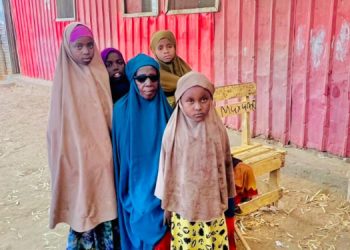


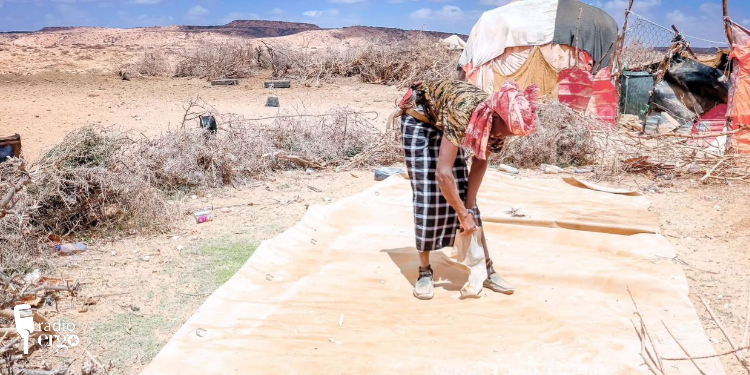
(ERGO) – More than 100 families who lost their livestock in Sanag region and migrated to Tib’arro village, about 22 kilometres east of Qardo in Puntland’s Bari region received food, water, and basic household items from local youth volunteers.
The assistance was organised by a group of young people in secondary schools and universities in Qardo. They mobilised resources from local communities, collecting small contributions from residents across the town and sharing them with the displaced families.
Ahmed Mohamed Nur, his wife and four children have been struggling to find enough to eat, after losing all their animals to drought in rural Sanag.
They were pleased to receive the donations of 25 kilograms each of flour, rice, and sugar, four litres of cooking oil, and a carton of dates in February. He said the supplies would last them around two months.
“We received the food and it reached us well. We had nothing before this, and our livestock were decimated. Now we have something to rely on,” Ahmed told Radio Ergo.
The families also received water delivered by tankers and poured into a plastic lined pit for sharing among the displaced households.
Ahmed and his family arrived in Tib’arro in January after losing around 90 camels and goats in the remote village of Baragaha-qol. The animals died due to a combination of pasture shortage, water scarcity, and disease, leaving the family without any source of income.
“All the livestock died. The drought wiped them out. For six months I couldn’t sell a single animal. That left me with debts of about $1,000 for food we had taken on credit,” he said.
Ahmed remains concerned about the lack of essential services in the area, including healthcare and education. He has tried to find casual labour in Qardo but has not succeeded so far.
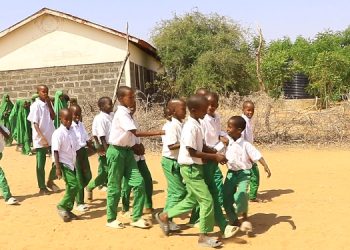
He is particularly concerned about his three school-age children, who had no access to education in their rural home but could have their first chance if he could find a new source of income near town.
Zainab Mohamed Abdullahi and her family of eight were given 75 kilograms of food, five litres of oil, and a carton of dates. She said the support lifted a heavy burden of uncertainty.
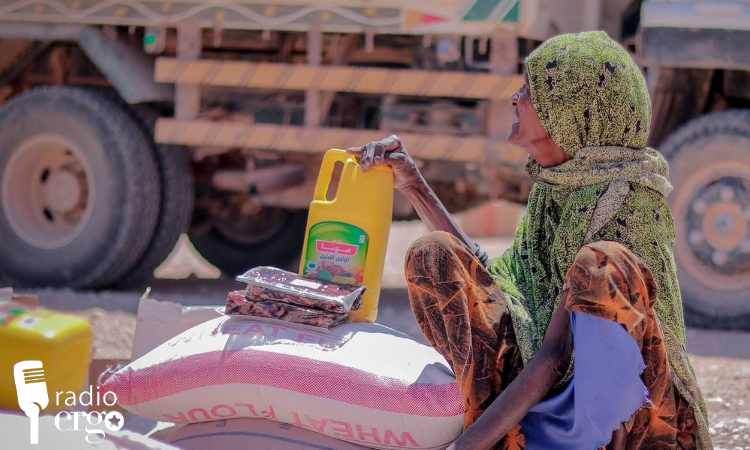
“The food reached us and every family received their share. Our situation is better now, but before it was very difficult. We used to worry about who would give us food on credit. Now we have something given to us, and we are not thinking about that constantly,” she said.
Zainab and her children have been depending on a host family in Tib’arro since arriving there in December. But the hosts cannot spare much food themselves.
Her husband, who is elderly and suffers from chronic illness, remained behind in Dhahar in Sanag under the care of relatives, while she brought the children to seek help. The last goat in their herd of 136 goats perished on 15 December, following two years of failed rainy seasons and outbreaks of livestock disease.
Zainab hasn’t been able to find any odd jobs to earn income. However, for now, her children seem in better condition.
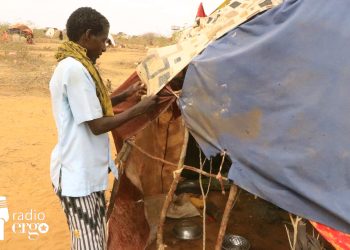
“When we arrived, the children were malnourished, but now they are better after eating the food and drinking the water we received,” she said. They live in a hut made with plastic sheets provided during the aid distribution.
She remains anxious about the future once the supplies run out. She has debts of around $600 owed to shops in her home area, which she is unable to repay.
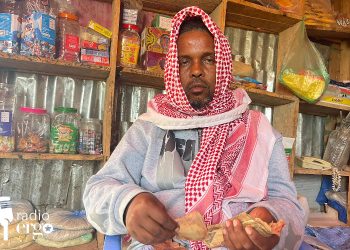
One of organisers of the assistance, Mohamed Khayre Ahmed, said they raised more than $4,000 in cash, along with donated food supplies and plastic sheeting for shelters.
“When we saw the condition of these people and the hardship especially among mothers, we decided to act. We went around markets and neighbourhoods collecting whatever people could give – even small amounts like $0.30 or $0.50,” he said.
They100 families they reached had not received any other support. Mohamed said they continued helping newly arriving families displaced by drought who are settling in Qardo and surrounding villages, although the needs remain high.